
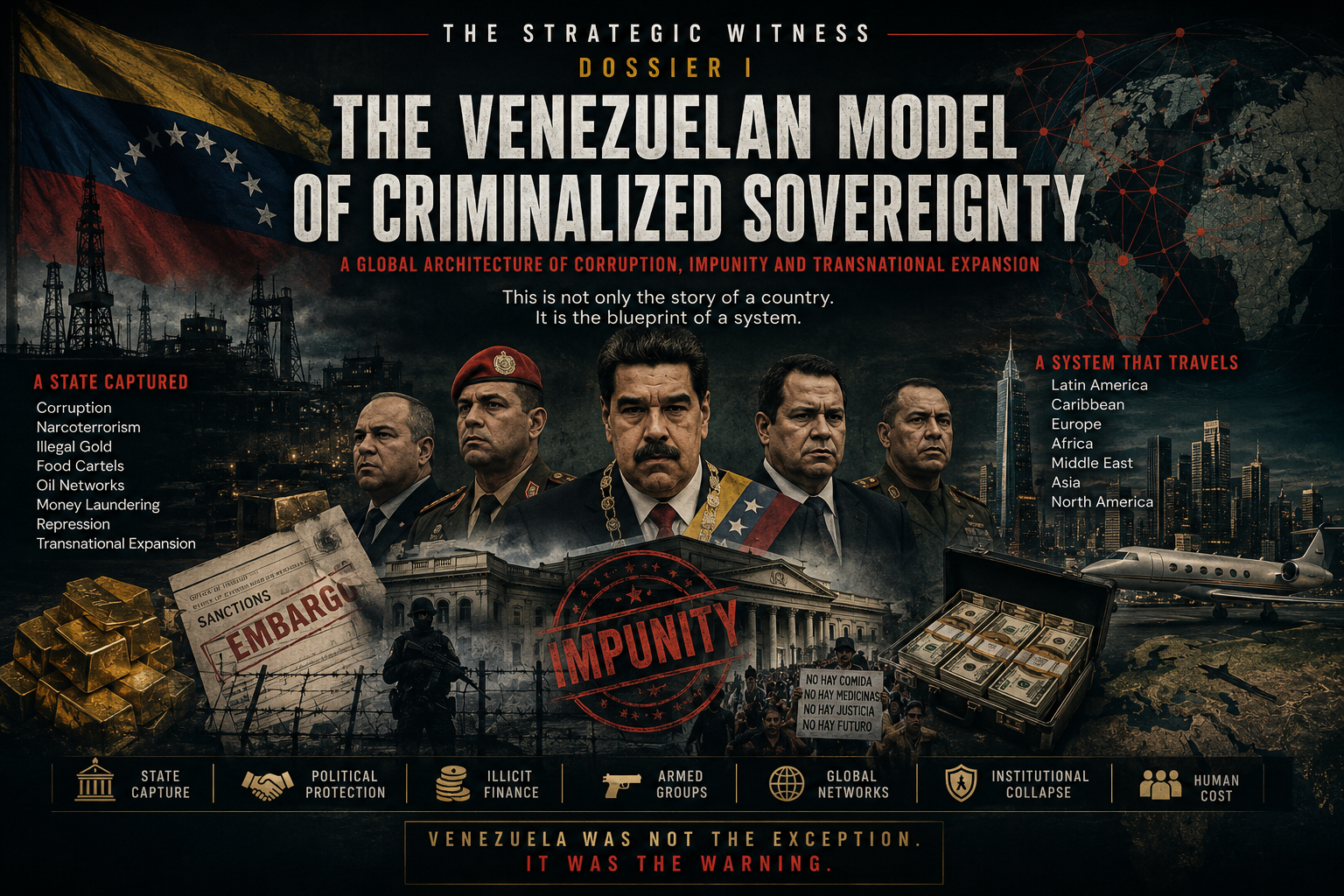
Venezuela, Civilization at the End of the War
How a Captured State Exported Corruption, Narcoterrorism, Money Laundering, Sanctions Evasion, and Political Decay Across the World
THE STRATEGIC WITNESS
GLOBAL DOSSIER No. 1
VERSION I - PUBLIC WEB DOSSIER
Founder’s Opening Note
Why The Strategic Witness Begins Here
The Strategic Witness begins here because Venezuela is no longer only the tragedy of one nation.
It is a warning.
It is a warning about what happens when a state is captured from within, when institutions are hollowed out, when corruption ceases to be an abuse of power and becomes the operating system of power itself. It is a warning about what happens when political ideology becomes a shield for criminality, when national wealth is converted into private fortunes, when hunger becomes a mechanism of control, when oil becomes a currency of impunity, when gold becomes an emergency bloodstream, and when narcoterrorism learns to move through the language of sovereignty.
This dossier is not written as an act of nostalgia, resentment, or partisan accusation. It is written as a strategic warning.
Venezuela was not destroyed in silence because the world did not know. Venezuela was destroyed while many looked away, negotiated, profited, rationalized, minimized, or chose the comfort of diplomatic ambiguity over the discipline of truth. The collapse of Venezuela was not merely a domestic failure. It became a global event: financial, criminal, geopolitical, institutional, humanitarian, and moral.
The purpose of The Strategic Witness is to examine precisely those spaces where power hides behind language, where criminal systems disguise themselves as political complexity, and where global institutions often react too late, too weakly, or not at all. This platform is born from the conviction that warning has value, that analysis has responsibility, and that silence in the face of organized decay is never neutral.
This first global dossier begins with Venezuela because Venezuela became one of the clearest prototypes of criminalized sovereignty in the modern world. Its tragedy reveals how a captured state can export corruption, money laundering, narcoterrorism, sanctions evasion, political influence, illicit gold, oil networks, criminal culture, and institutional decay far beyond its borders.
This is not a conventional article.
It is a dossier.
It is an attempt to connect fragments that are too often treated separately: PDVSA corruption, narcotrafficking, political protection, offshore finance, food corruption, sanctions evasion, gold routes, European influence networks, Caribbean corridors, Latin American complicities, global banking failures, and the international normalization of a regime that transformed national collapse into a transnational business model.
The Strategic Witness begins here because dangerous times require more than opinion. They require memory, evidence, structure, courage, and strategic clarity.
This dossier is offered as a first act of documentation and warning.
Not to explain Venezuela as a closed chapter.
But to show why Venezuela remains an unfinished lesson for the world.
1. Opening Statement
The Revolution That Became a Global Criminal System
Venezuela was not destroyed only by corruption.
That sentence is not enough.
Many countries suffer corruption. Many governments tolerate patronage. Many political systems are weakened by nepotism, bribery, ideological manipulation, clientelism, abuse of public resources, and the slow erosion of institutions. But Venezuela represents something deeper, darker, and more consequential. Venezuela was not merely mismanaged. It was captured. It was reorganized. It was converted into a transnational architecture of extraction, control, laundering, political protection, sanctions evasion, criminal logistics, and global complicity.
The Venezuelan tragedy is not only the story of a country that collapsed. It is the story of a state that was progressively hollowed out until its institutions became instruments of a different kind of power: a power that could speak the language of sovereignty while operating through the methods of organized criminality; a power that could invoke revolution while protecting privilege; a power that could denounce imperialism while moving money through foreign banks, offshore structures, luxury markets, real estate, commodity corridors, political intermediaries, and global financial systems.
This is why Venezuela matters beyond Venezuela.
The destruction of Venezuela cannot be understood as a domestic crisis alone. It became a regional crisis, then a hemispheric crisis, and eventually a global warning. Its collapse moved through borders in the form of migration, organized crime, illicit capital, narcotrafficking routes, gold networks, political influence operations, corrupted procurement systems, sanctions-evasion schemes, and transnational criminal partnerships. It contaminated institutions, markets, ports, banks, companies, political relationships, diplomatic channels, and security environments far beyond Caracas.
At the center of this system was not only ideology. Ideology provided language, symbolism, justification, and mobilization. But the deeper engine became extraction. The revolutionary state learned to extract from oil, from currency controls, from public contracts, from food imports, from mining, from gold, from international alliances, from criminal protection, from humanitarian dependency, and from the strategic ambiguity of a world that often preferred not to look too closely.
PDVSA, once the symbol of national energy power, became one of the central arteries of this transformation. Around it grew networks of bribery, inflated contracts, currency manipulation, intermediaries, financial operators, political insiders, and offshore structures. Oil wealth that should have sustained a nation was diverted into private fortunes, political survival, foreign influence, and systems of concealment. The looting of public wealth did not remain trapped inside Venezuela. It traveled. It entered banks. It bought properties. It moved through shell companies. It passed through professional enablers. It crossed into Europe, the United States, Latin America, the Caribbean, and beyond.
But oil was only one layer.
As sanctions increased and the regime’s access to conventional financial channels became more constrained, the system adapted. It moved into darker corridors: gold, shadow trade, opaque commodity flows, rebranded oil, ship-to-ship transfers, foreign intermediaries, allied sanctioned states, and alternative markets willing to absorb risk in exchange for advantage. Sanctions did not end the system. They forced it to mutate. They pushed it toward a more complex, more global, more clandestine economy of survival.
Then there was hunger.
One of the most morally devastating dimensions of the Venezuelan collapse was not only that people were impoverished, but that poverty itself became a political instrument. Food distribution became a mechanism of dependency. Humanitarian need became a field of procurement. Scarcity became a method of control. Networks connected to the CLAP food program exposed how even hunger could be transformed into business, leverage, and international enrichment. A revolution that claimed to speak for the poor ended up monetizing the desperation of the poor.
Then there was narcoterrorism.
The Venezuelan case forces the world to confront a difficult reality: organized crime and state power are no longer always separate categories. Under certain conditions, criminal markets do not merely corrupt institutions from the outside; they become embedded inside them. Drug trafficking, armed groups, military protection, territorial corridors, illicit mining, and political impunity can converge into a hybrid system where sovereignty itself becomes a shield for criminal logistics. This is the deeper meaning of the Venezuelan warning. It shows how a state can cease to be only a victim of criminal penetration and become, in strategic terms, an enabling platform for transnational criminal power.
This does not mean that every institution, every official, every soldier, every Venezuelan, or every migrant belongs to that system. That distinction is essential. The Venezuelan people are the primary victims of this tragedy. Millions fled not because they wanted to abandon their country, but because the country they knew was taken from them by a system that converted national life into permanent coercion, scarcity, fear, humiliation, and survival. The criminalization of the state must never be confused with the dignity of the people who suffered under it.
But precisely because the Venezuelan people are victims, the truth must be spoken with clarity.
The world did not merely observe Venezuela’s collapse. Parts of the world profited from it. Banks processed money. Real estate markets absorbed capital. Lawyers and consultants built structures. Traders moved oil. Companies pursued contracts. Political figures offered legitimacy. Foreign governments made calculations. Criminal groups found corridors. Sanctioned actors found partners. And many institutions, even when they knew enough to be alarmed, chose caution, silence, ambiguity, or delay.
This is the scandal beneath the scandal.
The Venezuelan disaster was not invisible. It was documented, denounced, investigated, sanctioned, litigated, and reported across multiple jurisdictions for years. Yet the system survived because it operated inside the gaps of the international order: between law and enforcement, between diplomacy and complicity, between sanctions and loopholes, between political ideology and criminal evidence, between human rights rhetoric and strategic action.
The result was not simply corruption.
It was a model.
A model of criminalized sovereignty.
A model of institutional capture.
A model of sanctions adaptation.
A model of political protection.
A model of transnational laundering.
A model of narcoterrorist convergence.
A model of how a state can collapse internally while expanding its corrupt influence externally.
This dossier begins with Venezuela because Venezuela is one of the clearest warnings of the age. It shows what happens when a political project destroys institutional limits, when loyalty replaces law, when power becomes immune to accountability, when criminal networks learn to operate through state structures, and when the international system mistakes survival for stability.
The Strategic Witness does not begin with a comfortable subject. It begins with a necessary one.
It begins here because dangerous times require more than commentary. They require documentation. They require structure. They require the courage to connect what power prefers to keep fragmented. They require the discipline to distinguish allegation from evidence, propaganda from fact, and political noise from strategic pattern. They require witnesses who do not merely react to collapse after it becomes visible, but study the mechanisms that make collapse possible.
This is not an opinion piece.
It is a dossier.
It is the first file of The Strategic Witness because Venezuela must be understood not as a closed national tragedy, but as an unfinished global warning. The revolution did not only destroy a country. It built networks, exported decay, empowered predators, corrupted institutions, and revealed the vulnerabilities of a world willing to tolerate criminal power when it arrives wrapped in ideology, contracts, diplomacy, oil, gold, or silence.
Venezuela was not the exception.
Venezuela was the warning.
2. The Anatomy of a Captured State
A captured state does not simply fail.
It reorganizes itself around impunity.
This is the central lesson of Venezuela. The collapse was not merely the result of bad governance, economic incompetence, ideological excess, corruption, or administrative decay. Those elements existed, but they do not fully explain the transformation. Venezuela’s tragedy was deeper because the state did not disappear. It remained. It continued to issue laws, hold elections, command security forces, manage ministries, control courts, operate intelligence agencies, negotiate internationally, sign contracts, distribute resources, regulate currency, control ports, supervise borders, and speak the language of national sovereignty.
But behind that institutional appearance, the function of the state had changed.
The state was no longer organized primarily to serve citizens, protect rights, administer justice, preserve institutional balance, or defend the public interest. It was progressively reorganized to protect power, reward loyalty, punish dissent, extract wealth, manage scarcity, control society, and guarantee impunity for those inside or connected to the ruling structure. The outer form of government remained. The inner logic was transformed.
This is what state capture means in its most dangerous form.
It is not only the bribery of officials. It is not only the theft of public money. It is not only the appointment of loyalists to strategic offices. Those are symptoms. The deeper process is the conversion of institutions into instruments of domination, extraction, and protection. Courts stop being neutral arbiters and become political shields. Security forces stop being servants of public order and become guardians of regime survival. Electoral bodies stop being mechanisms of democratic legitimacy and become mechanisms of managed continuity. Public companies stop being national assets and become channels of enrichment. Intelligence services stop being tools of national security and become instruments of internal fear.
In Venezuela, political loyalty gradually replaced institutional duty.
That replacement did not happen overnight. It advanced through appointments, purges, patronage, intimidation, ideological indoctrination, selective prosecution, militarization of public administration, and the progressive destruction of independent oversight. The question asked of officials was no longer whether they served the law, but whether they served the project. Professional competence became secondary to political obedience. Institutional autonomy became suspicious. Technical disagreement became disloyalty. Neutral administration became almost impossible in a system where neutrality itself was treated as a threat.
Once loyalty becomes the organizing principle of the state, institutions lose their internal immune system.
A normal institution contains resistance mechanisms: legal standards, professional ethics, bureaucratic procedures, independent review, internal dissent, judicial oversight, media scrutiny, parliamentary accountability, and the possibility of sanction. A captured institution still has offices, titles, uniforms, seals, budgets, regulations, and official language. But those mechanisms no longer function as barriers against abuse. They become decorative, selective, or reversible. Procedure remains, but justice disappears. Law remains, but legality becomes an instrument. Elections remain, but competition is neutralized. Courts remain, but accountability is redirected against enemies while protecting allies.
The state becomes both shield and weapon.
It becomes a shield because it protects the ruling network from consequence. Investigations are blocked, files disappear, judges are pressured, prosecutors are aligned, security forces intimidate, and public narratives are manufactured to convert corruption into political persecution or foreign conspiracy. The state’s legal and diplomatic personality is used to protect private criminal or corrupt interests. Sovereignty is invoked not to defend the nation, but to prevent scrutiny.
It becomes a weapon because the same institutions are used against those who resist. Political opponents, journalists, judges, military officers, civil society leaders, students, union organizers, human rights defenders, business figures, and ordinary citizens can be targeted through criminal investigations, administrative pressure, surveillance, arbitrary detention, property seizures, public defamation, passport restrictions, forced exile, or fear. The state’s coercive capacity is no longer restrained by institutional ethics. It is redirected toward regime preservation.
This is the architecture of captured power.
The military dimension is essential. In a democratic state, the armed forces are subordinate to constitutional order. In a captured state, sectors of the military become part of the political economy of survival. Loyalty is rewarded not only with rank or symbolic privilege, but with access: access to contracts, ports, food distribution, mining, fuel, foreign currency, border zones, public companies, security monopolies, and protected businesses. The result is not merely militarization. It is the fusion of command, patronage, coercion, and economic privilege.
The intelligence dimension is equally central. Intelligence services in a healthy state identify threats to national security. In a captured state, the definition of threat is inverted. The citizen becomes suspicious. The opposition becomes an enemy. Independent journalism becomes destabilization. Civil society becomes foreign interference. Human rights documentation becomes subversion. The intelligence apparatus no longer protects society from danger; it helps protect power from society.
The judicial dimension completes the system. Without independent courts, abuse becomes sustainable. A captured judiciary does not need to criminalize everyone. It only needs to create uncertainty, fear, and selective punishment. It must teach the population that justice is not a neutral process but a political risk. When courts lose autonomy, detention can become a message, prosecution can become discipline, and impunity can become currency.
The electoral dimension gives the system its external mask. Elections can still occur. Campaigns can still be announced. Parties can still exist. International observers can still be discussed. Ballots can still be printed. But the conditions surrounding political competition are degraded: media access, candidate eligibility, judicial neutrality, voter confidence, institutional transparency, party registration, campaign freedom, and the publication or verification of results. The captured state does not always abolish elections. Often, it empties them from within.
The economic dimension turns capture into a business model.
Once the state controls access to oil revenues, currency systems, import licenses, public contracts, ports, customs, mining zones, food distribution, fuel, credit, permits, and legal protection, power becomes the gateway to wealth. Corruption is no longer peripheral. It becomes structural. The economy becomes an ecosystem of permission. Those close to power receive access. Those outside power face obstacles. Those who resist can be destroyed. Those who collaborate can be enriched.
This is how institutional capture becomes transnational.
The captured state produces money that must leave, assets that must be hidden, contracts that must be disguised, partners that must be recruited, banks that must be used, lawyers that must structure transactions, properties that must absorb capital, commodities that must be traded, and foreign political relationships that must provide legitimacy. Domestic capture creates external networks. Internal impunity seeks international protection. The national looting of Venezuela became a global operation because captured states do not only consume wealth internally; they export it through the world’s financial, legal, commercial, political, and criminal systems.
The tragedy is that many outside observers continued to analyze Venezuela as if it were only a failed socialist experiment, an authoritarian government, a humanitarian emergency, or a polarized political conflict. It was all of those things. But it was also something more advanced and more dangerous: a system in which ideology, corruption, organized crime, state institutions, international finance, coercive power, and geopolitical alliances became mutually reinforcing.
That is why the Venezuelan case matters beyond its borders.
It shows that state capture is not a metaphor. It is a method. It is a sequence. It begins by weakening institutional independence. It continues by replacing competence with loyalty. It expands by converting public resources into private networks. It deepens by subordinating courts, security forces, electoral bodies, intelligence services, and public companies. It protects itself by criminalizing opposition and manufacturing narratives of external aggression. It survives by building international corridors for money, influence, commodities, and legitimacy.
A captured state does not simply collapse into chaos.
It learns to govern through chaos.
It creates scarcity and then controls access to survival. It destroys trust and then demands obedience. It ruins the economy and then monopolizes opportunity. It produces fear and then sells protection. It invokes sovereignty and then uses that sovereignty to shield predation. It claims to defend the people while turning the people into hostages of dependency, propaganda, coercion, and exile.
This is the anatomy of the Venezuelan captured state.
Not a government that merely failed.
A system that reorganized itself around impunity.
A state that became a shield for those inside power and a weapon against those outside it.
A national tragedy converted into a global warning.
3. PDVSA: The Oil Company That Became a Global Black Box
PDVSA was not merely looted.
It became the financial infrastructure through which a captured state converted public wealth into private power.
For decades, Petróleos de Venezuela S.A. was more than an oil company. It was the economic heart of the Venezuelan republic. It financed public spending, international credibility, infrastructure, foreign policy, social programs, diplomatic leverage, and the national imagination itself. Oil was not only Venezuela’s principal export. It was the bloodstream of the state.
That is why the capture of PDVSA was not just an act of corruption. It was the capture of the country’s central artery.
When a normal public company is corrupted, contracts are manipulated, officials are bribed, assets are diverted, and public money is stolen. But when a company like PDVSA is captured, the damage moves far beyond balance sheets. The entire state is compromised. The national budget is compromised. Foreign policy is compromised. Public services are compromised. Institutional independence is compromised. The future of millions of citizens is compromised.
PDVSA became the place where political loyalty, economic privilege, public contracting, currency manipulation, international finance, and criminal opportunity converged.
The company’s transformation cannot be understood only through the language of mismanagement. Mismanagement explains decline. It does not explain the sophistication of the laundering networks, the multiplicity of jurisdictions, the offshore structures, the currency exchange schemes, the private bankers, the luxury assets, the real estate acquisitions, the shell companies, and the repeated appearance of politically connected operators across multiple international investigations.
The deeper pattern was extraction.
The captured state extracted from PDVSA in several ways. It extracted through inflated contracts. It extracted through procurement fraud. It extracted through preferential access to foreign currency. It extracted through debt operations. It extracted through politically connected intermediaries. It extracted through fictitious services, overpricing, commissions, bribes, and the use of public contracts as vehicles for private enrichment. It extracted not only money, but power: the power to reward allies, buy silence, build international networks, finance influence, and sustain political control.
This is why PDVSA became a global black box.
Money entered through oil, contracts, currency operations, and state-controlled transactions. Then it disappeared into layers of financial opacity. It moved through banks, shell companies, private investment vehicles, real estate markets, luxury goods, offshore accounts, and professional intermediaries. It crossed borders. It changed form. It acquired legal packaging. It entered jurisdictions where the origin of the funds could be blurred, disputed, or hidden behind complex corporate structures.
The logic was simple but devastating: public wealth was converted into private liquidity, private liquidity into foreign assets, foreign assets into political insulation, and political insulation into continued impunity.
Several major cases illustrate the scale and architecture of the system.
One of the most emblematic is the network associated with Raúl Gorrín, Alejandro Andrade, and currency exchange operations connected to the Venezuelan state. According to U.S. authorities, Andrade, a former Venezuelan national treasurer, admitted that he received more than one billion dollars in bribes from Gorrín and other co-conspirators in exchange for using his position to select them for foreign currency exchange transactions at favorable rates. The alleged benefits were not abstract. They reportedly included private jets, yachts, homes, champion horses, high-end watches, luxury assets, and payments structured through multiple shell companies.
This was not petty corruption.
It was a financial ecosystem built around privileged access to the state.
Currency controls were essential to the model. When a government controls access to dollars in a distorted economy, foreign currency becomes more than a financial instrument. It becomes a political weapon and a corruption machine. Those granted access to preferential exchange rates can generate extraordinary profits. Those excluded remain trapped. The system creates artificial scarcity, privileged intermediaries, and opportunities for enormous arbitrage. In Venezuela, currency manipulation became one of the great engines of illicit enrichment.
PDVSA was central because oil revenues generated the hard currency that made the entire architecture possible.
The company’s wealth fed the state. The state controlled access. Access generated privilege. Privilege generated bribes. Bribes required laundering. Laundering required banks, lawyers, accountants, shell companies, private wealth managers, real estate agents, and jurisdictions willing to look the other way or unable to understand the full strategic nature of what was unfolding.
The case of Luis Fernando Vuteff and Ralph Steinmann further exposes the international dimension of the PDVSA laundering architecture. U.S. prosecutors alleged that they participated in a scheme connected to the laundering of proceeds from a corrupt foreign currency exchange operation involving bribes to Venezuelan officials. Their case illustrates how the PDVSA corruption network did not remain in Venezuela. It moved through Europe, Switzerland, Malta, Spain, the United States, and other financial spaces. Vuteff later pleaded guilty in the United States, becoming another example of how Venezuelan state corruption required international financial specialists to move, protect, and disguise proceeds.
The role of Matthias Krull, a former Swiss bank executive, also reveals the importance of private banking in this ecosystem. His guilty plea in connection with a billion-dollar international money-laundering scheme showed how Venezuelan clients connected to corruption could be attracted, managed, and serviced through sophisticated financial institutions. The scandal was not simply that Venezuelan money left Venezuela. The scandal was that global financial architecture repeatedly provided the tools through which the money could be received, structured, and legitimized.
Andorra represents another critical node. Banca Privada d’Andorra became one of the most significant European symbols of Venezuelan corruption abroad. U.S. financial authorities described how high-level managers at the bank facilitated transactions connected to Venezuelan third-party money launderers and shell structures used to siphon funds from PDVSA. European reporting later revealed how former Venezuelan officials and politically connected figures used Andorran banking channels to hide enormous sums linked to commissions and contracts involving the Venezuelan oil sector.
This was the geography of the black box: Caracas generated the money; PDVSA provided the source; state officials provided access; intermediaries structured the transactions; banks moved the funds; offshore entities concealed ownership; real estate and luxury assets absorbed capital; and foreign jurisdictions gave distance, complexity, and plausible deniability.
The Dominican Republic also appears in this architecture through Banco Peravia and Gabriel Jiménez Aray. U.S. authorities alleged that Gorrín partnered with Jiménez to acquire the bank and use it to launder bribes and proceeds connected to Venezuelan government schemes. That detail matters because it shows the strategic use of financial institutions not merely as passive recipients of suspicious money, but as potential operational platforms within a broader laundering structure.
Argentina has now become another significant jurisdiction in the PDVSA map through the case of Luis Fernando Vuteff. Argentine proceedings have examined assets, investments, vehicles, real estate, financial instruments, and possible laundering connected to funds derived from the Venezuelan oil-corruption ecosystem. The point is not that Argentina created the system. The point is that the system was transnational enough to leave traces in Argentina, Spain, Switzerland, Malta, Miami, Panama, the Dominican Republic, Andorra, and beyond.
That is what makes PDVSA so important to the global story.
The company was not just robbed by corrupt individuals. It became the origin point of international financial contamination. Its revenues, contracts, debt instruments, exchange mechanisms, and political relationships generated flows of money that entered the global system through multiple doors. Some doors were banking doors. Others were legal doors. Others were corporate doors. Others were political doors. Others were real estate doors. Others were criminal doors.
The world often treated these cases as isolated scandals: a banker here, a treasurer there, a businessman in Miami, a money manager in Europe, a minister in Spain, a shell company in Panama, a property in Madrid, an account in Switzerland, a bank in Andorra, a financier in Argentina.
But the pattern is larger than the fragments.
The fragments reveal a system.
PDVSA became the captured state’s financial engine because it concentrated the one thing the regime needed most: internationally convertible value. Oil could become dollars. Dollars could become bribes. Bribes could become property. Property could become status. Status could become influence. Influence could become protection. Protection could become impunity.
This is why PDVSA belongs at the center of any serious analysis of Venezuelan criminalized sovereignty.
It was not only a company.
It was a treasury.
It was a political bank.
It was a patronage machine.
It was a currency gatekeeper.
It was a source of international leverage.
It was a laundering origin point.
It was a mechanism through which the captured state converted national resources into global networks of private enrichment and political survival.
The damage to Venezuela was catastrophic. Hospitals collapsed while fortunes were moved abroad. Infrastructure deteriorated while luxury assets were acquired. Citizens queued for food and medicine while politically connected actors purchased properties, horses, watches, aircraft, and foreign security. The moral obscenity of the system is that national suffering and private enrichment advanced at the same time.
This is the deeper meaning of PDVSA’s collapse.
It was not simply that oil production fell.
It was not simply that management deteriorated.
It was not simply that corruption expanded.
It was that the country’s most important public asset was transformed into a global mechanism of extraction.
A captured state needs money to survive. PDVSA gave it money. It needs loyalty. PDVSA financed loyalty. It needs international partners. PDVSA created transactions. It needs foreign influence. PDVSA produced leverage. It needs secrecy. PDVSA generated flows that could be hidden. It needs impunity. PDVSA’s networks helped buy distance from accountability.
That is why the story of PDVSA is not an accounting scandal.
It is the financial anatomy of a criminalized state.
And until the world understands PDVSA not only as an oil company, but as one of the central instruments through which Venezuelan public wealth was converted into private power, foreign assets, criminal liquidity, and political survival, the full architecture of the Venezuelan disaster will remain misunderstood.
PDVSA was not merely looted.
It became the global black box of the revolution.
4. Narcoterrorism and the Cartelization of Power
Venezuela demonstrates that narcoterrorism can move from the margins of the state into the operating logic of power itself.
This is one of the most difficult truths the Venezuelan case forces the world to confront. For decades, the international community tended to analyze narcotrafficking, terrorism, insurgency, corruption, and state power as separate categories. Drug traffickers were criminals. Guerrilla groups were insurgents. Terrorist organizations were ideological or religious actors. States were sovereign entities, sometimes weak, sometimes corrupt, sometimes authoritarian, but still conceptually distinct from criminal networks.
Venezuela breaks that comfortable separation.
The Venezuelan case reveals a more dangerous model: a political-criminal environment in which elements of the state, armed groups, narcotrafficking networks, intelligence structures, military actors, border authorities, and international criminal corridors can become mutually reinforcing. In this model, organized crime does not merely penetrate the state from the outside. It finds protection inside the state. It uses state territory. It benefits from state corruption. It moves through state-controlled infrastructure. It negotiates with state-linked actors. It exploits diplomatic ambiguity. It survives behind the shield of sovereignty.
This is the essence of narcoterrorism in the Venezuelan context.
It is not only about cocaine. It is not only about armed groups. It is not only about corruption. It is about the convergence of criminal finance, political protection, territorial control, coercive capacity, and ideological cover. It is about the creation of an environment where illicit markets are not accidental distortions of public order, but part of the broader architecture through which power is financed, protected, and projected.
The term “Cartel de los Soles” must be handled with precision. It has been widely used to describe the alleged involvement of Venezuelan military figures and state-linked actors in drug trafficking. It does not necessarily describe a single centralized cartel with a traditional command structure like the Mexican cartels. In strategic terms, it is better understood as a framework of military-political-criminal convergence: a constellation of actors, factions, relationships, protections, routes, permissions, and illicit opportunities operating within or around state structures.
That distinction matters.
If the world imagines the Cartel de los Soles only as a conventional cartel, it may misunderstand the threat. The danger is not simply that a group of officers allegedly participated in drug trafficking. The danger is that criminality became embedded in zones of authority: airports, ports, military installations, border corridors, intelligence networks, customs systems, judicial protection, territorial governance, and political decision-making. The cartelization of power is not only the creation of a cartel. It is the conversion of public authority into a marketable criminal asset.
This is why the U.S. indictments against Nicolás Maduro and other senior Venezuelan figures were so significant. They placed before the world an allegation of historic gravity: that senior political and military actors in Venezuela conspired with FARC leadership and other actors in a narco-terrorism partnership. Whether every allegation will be proven in court is a legal question. But as a strategic document, the indictments exposed the central analytical issue: the possible use of state power to protect, facilitate, or benefit from narcotrafficking and armed criminal activity.
In Venezuela, geography became destiny — and then strategy.
The country borders Colombia, the world’s most important cocaine-producing country. It possesses long, porous frontiers, remote jungle corridors, coastal access to the Caribbean, air routes, riverine systems, weak institutional oversight, corruptible security structures, and proximity to maritime corridors leading toward Central America, the Caribbean, Europe, West Africa, and North America. Under conditions of institutional decay, such geography becomes an asset for criminal logistics.
Colombian armed groups understood this. FARC dissidents, ELN factions, and other criminal actors found in Venezuelan territory not only refuge, but opportunity. Border areas became zones of illicit governance. Armed groups could control routes, tax populations, manage illegal economies, establish relationships with local authorities, exploit mining zones, regulate communities, use clandestine airstrips, and integrate themselves into the social and economic life of abandoned territories.
The ELN’s presence is especially important. In parts of Venezuela, the ELN has reportedly exercised forms of de facto governance, including extortion, territorial control, social regulation, illegal mining involvement, and participation in cross-border criminal economies. This is not merely an external Colombian problem spilling into Venezuela. It is part of a broader pattern in which the weakness or complicity of state structures allows foreign armed actors to operate with unusual depth inside national territory.
FARC dissidents also matter because they show the afterlife of insurgent-criminal adaptation. After the formal peace process in Colombia, not all armed structures disappeared. Some factions mutated, fragmented, relocated, or reorganized around criminal economies. Venezuelan territory became strategically useful for movement, protection, production, transit, and pressure against Colombia. The result was a borderland environment where ideology, narcotrafficking, survival, territorial control, and political utility could overlap.
This is the Venezuelan narcoterrorist warning: when a state becomes permissive, captured, complicit, or strategically ambiguous toward armed criminal actors, territory itself becomes a platform.
Cocaine routes illustrate this transformation. Venezuela is not the principal producer of cocaine in the hemisphere, but it has become a critical transit and facilitation space. Cocaine can move from Colombia into Venezuelan territory and then onward through air, maritime, land, and Caribbean corridors. Some routes point toward Central America and Mexico; others toward the Caribbean; others toward Europe; others toward West Africa as a historical transshipment zone; and others into broader global markets. The specific route may change, but the strategic function remains: Venezuela became a permissive corridor.
Permissive corridors are not created only by geography. They require protection, corruption, fear, institutional weakness, and selective enforcement. A border can be porous, but it becomes criminally strategic when officials can be bribed, commanders can be compromised, judges can be neutralized, intelligence can be redirected, ports can be controlled, airstrips can be tolerated, and criminal actors can operate with confidence that consequences will be limited or negotiable.
This is where narcotrafficking becomes political.
Drug money is not only profit. It is power. It buys protection. It finances networks. It corrupts institutions. It pays armed groups. It purchases silence. It supports patronage. It strengthens territorial control. It generates liquidity outside formal budgets. It creates relationships with foreign criminal organizations. It allows political actors to survive sanctions, economic collapse, and institutional isolation.
In such an environment, narcoterrorism becomes more than a criminal enterprise. It becomes a system of protection, finance, and coercive power.
Protection is the first pillar. Armed groups and traffickers require safe movement, controlled routes, protected airstrips, access to ports, impunity from prosecution, and the ability to operate near or within zones nominally controlled by the state. Protection does not always require formal orders from the top. It can function through local arrangements, military complicity, intelligence tolerance, judicial paralysis, corrupt police networks, or political calculation.
Finance is the second pillar. Drug trafficking generates hard currency and liquidity. In a sanctioned, collapsing, or isolated economy, illicit finance becomes even more valuable. It provides resources that are not subject to normal parliamentary oversight, budgetary transparency, public accountability, or conventional banking scrutiny. It can support patronage systems, armed actors, personal enrichment, influence operations, and survival networks.
Coercion is the third pillar. Narcoterrorist systems are not only about making money. They govern through fear. They intimidate communities, silence witnesses, displace rivals, discipline populations, recruit youth, punish dissent, and impose parallel authority. In border zones and mining regions, criminal power can become the law that people actually experience.
This is why narcoterrorism must be analyzed together with state capture. A captured state creates the conditions for criminal protection. Criminal protection generates illicit finance. Illicit finance strengthens captured power. Captured power then shields the criminal economy. The system becomes circular.
The same pattern can be seen in the relationship between narcotrafficking and illegal mining. Armed groups that participate in drug routes may also exploit gold, coltan, fuel smuggling, extortion, human trafficking, arms trafficking, and contraband. Criminal economies converge. Routes overlap. Personnel overlap. Protection networks overlap. Corrupt officials do not necessarily distinguish between one illicit market and another. They monetize access, silence, and control.
This is the cartelization of power.
Not a single cartel ruling the state from a hidden office.
Not a simplistic image of one boss giving orders to everyone.
But a fragmented, adaptive, state-embedded criminal ecosystem in which public authority, criminal markets, political survival, and armed coercion intersect.
The danger of this model is that it is resilient. Killing or arresting one actor does not dismantle the system if the permissions, incentives, protections, and institutional decay remain intact. A trafficker can be replaced. A route can shift. An armed group can fragment. A military faction can reorganize. A political broker can fall. But if the captured state remains, the criminal economy regenerates.
This is why Venezuela is not only a law-enforcement problem.
It is a strategic security problem.
It affects Colombia because armed groups use Venezuelan territory. It affects the Caribbean because maritime corridors move drugs, weapons, people, and contraband. It affects Europe because cocaine routes reach European ports and criminal markets. It affects West Africa because transshipment networks have historically linked Latin American cocaine to European demand. It affects the United States because U.S. authorities have alleged direct threats from Venezuelan-linked narcotrafficking networks and have used sanctions, indictments, rewards, and financial tools against senior actors. It affects Latin America because Venezuelan criminal collapse has contributed to a wider regional ecosystem of trafficking, extortion, illegal mining, and human exploitation.
But most of all, it affects the Venezuelan people.
They are the first victims of the cartelization of power. They live with militarized corruption, predatory officials, armed groups, failed institutions, coerced silence, economic ruin, and criminal governance. They suffer when border communities are abandoned, when youth are recruited, when indigenous territories are invaded, when miners are exploited, when women are trafficked, when families flee, and when the state that should protect them becomes indifferent, complicit, or predatory.
The world must understand this clearly: narcoterrorism in Venezuela is not a side issue. It is not an isolated criminal file. It is one of the core mechanisms through which state decay became transnational power.
Venezuela demonstrates that narcoterrorism can evolve beyond the margins. It can become embedded in the operating logic of a captured state. It can use territory without governing formally. It can use institutions without appearing in official structures. It can use sovereignty as protection. It can use ideology as camouflage. It can use corruption as infrastructure. It can use criminal finance as political oxygen.
That is the warning.
When corruption captures institutions, and criminal actors capture corridors, and armed groups capture territory, and political power captures the law, the result is no longer ordinary organized crime.
It is criminalized sovereignty.
And in the Venezuelan case, narcoterrorism became one of its most dangerous expressions.
5. The Global Laundering Machine
The money moved because the world had systems ready to receive it, disguise it, protect it, and profit from it.
This is the uncomfortable truth at the center of the Venezuelan case. The looting of Venezuela did not become global only because corrupt Venezuelan officials, businessmen, military actors, financial operators, and politically connected intermediaries wanted to move money abroad. It became global because the international system already contained the architecture required to transform stolen public wealth into apparently legitimate private assets.
Dirty money does not travel alone.
It travels with lawyers.
It travels with bankers.
It travels with accountants.
It travels with consultants.
It travels with real estate agents.
It travels with wealth managers.
It travels with corporate service providers.
It travels with shell companies.
It travels with nominee directors.
It travels with offshore jurisdictions.
It travels with contracts, invoices, trusts, foundations, investment vehicles, luxury purchases, and professional silence.
This is why corruption becomes most dangerous when it leaves the country where it was born. Inside Venezuela, stolen money represented plunder. Outside Venezuela, it became liquidity, investment, property, status, access, and influence. Once it crossed borders, it could be restructured. Once it entered professional systems, it could be explained. Once it acquired legal packaging, it could be defended. Once it entered real estate, private banking, luxury markets, or corporate vehicles, it could begin the long process of reputational transformation.
The laundering machine did not erase the crime in one movement. It diluted it through layers.
A corrupt payment could become a consulting fee.
A bribe could become a corporate transfer.
A public contract commission could become an offshore investment.
A diverted oil payment could become a property purchase.
A currency exchange profit could become a luxury asset.
A shell company could become the owner of another shell company.
A politically exposed person could disappear behind a relative, associate, nominee, or trusted intermediary.
This was not only money laundering in the narrow technical sense. It was the laundering of origin, ownership, reputation, power, and consequence.
The Venezuelan case demonstrates how stolen public wealth can be transformed into global presence. Money extracted from oil, currency manipulation, food imports, public contracts, mining, procurement, or narcotrafficking-linked protection could move through a chain of conversion. First, it was separated from its source. Then it was layered through financial and corporate structures. Then it was integrated into assets that appeared normal: homes, apartments, companies, bank accounts, aircraft, horses, watches, vehicles, investment portfolios, and luxury goods.
Real estate became one of the most visible doors.
Miami, South Florida, Houston, Madrid, and other property markets offered more than buildings. They offered distance. They offered prestige. They offered asset preservation. They offered anonymity through companies. They offered a way to convert political corruption into family wealth. A luxury apartment could be more than a residence. It could be a storage device for stolen national value. A mansion could be more than a home. It could be a monument to institutional failure. A commercial property could be more than an investment. It could be a laundering instrument.
Private banking offered another door.
For politically exposed clients, private banking can become a battlefield between compliance and appetite. When institutions perform their duties rigorously, they can detect suspicious flows, reject illicit wealth, and protect the financial system. But when greed, negligence, weak due diligence, internal complicity, or excessive deference to wealth prevail, private banking becomes a sanctuary for corruption. The Venezuelan money-laundering cases show the importance of this world: relationship managers, cross-border accounts, wealth structures, offshore entities, and financial professionals capable of translating suspicious wealth into sophisticated portfolios.
Offshore jurisdictions provided additional layers.
Panama, the British Virgin Islands, Malta, the Dominican Republic, Andorra, Switzerland, and other financial or corporate spaces appear repeatedly in different Venezuelan-linked cases because they offered tools that could be used for legitimate business, but also abused for concealment. A shell company is not automatically criminal. An offshore account is not automatically illegal. A trust is not automatically corrupt. But in the hands of politically connected looters, these structures can become instruments of invisibility.
The purpose was not only to move money.
The purpose was to make ownership difficult to prove.
To make origin difficult to trace.
To make responsibility difficult to assign.
To make prosecution slow.
To make confiscation complicated.
To make public outrage fade before the paperwork was understood.
This is the genius and obscenity of financial opacity: it converts theft into complexity.
Andorra became one of the most symbolic cases because it showed how a small European banking jurisdiction could become connected to massive Venezuelan corruption flows. Banca Privada d’Andorra became a reference point in the study of how Venezuelan public money, commissions, and politically connected wealth moved through European financial channels. The lesson is not only that money was hidden there. The deeper lesson is that the Venezuelan corruption system needed foreign professional infrastructure to survive.
Switzerland also appears as a recurring reference because of private banking, wealth management, and the role of financial professionals in handling Venezuelan-linked funds. Swiss institutions and bankers have appeared in multiple investigations connected to Venezuelan money, including cases involving PDVSA-related corruption and foreign currency schemes. The importance of Switzerland is not merely geographical. It represents the vulnerability of prestigious financial centers when politically exposed wealth is treated as opportunity before it is treated as risk.
Spain became another major space of legitimization. For Venezuelan elites, Spain offered language, culture, property, political access, business networks, legal services, banking proximity, and a gateway into Europe. Madrid and other Spanish cities became natural destinations for capital, families, companies, and reputational reconstruction. In some cases, Spain functioned as refuge. In others, as platform. In others, as market. In others, as political corridor. The Venezuelan system did not only export money into Spain; it exported influence, relationships, narratives, and unresolved legal risk.
The Dominican Republic appears in the laundering map through banking and financial cases connected to Venezuelan corruption networks. Panama appears as a corporate and offshore corridor. Malta appears in connection with European financial vehicles and money movement. The British Virgin Islands appear as a classic shell-company jurisdiction. Miami appears repeatedly because of real estate, finance, family presence, luxury consumption, and law-enforcement visibility. Houston matters because energy, oil-linked business, and Venezuelan capital intersected there in ways that required scrutiny.
Each jurisdiction played a different role. None should be reduced to a caricature. The issue is not that an entire country became criminal. The issue is that specific systems within multiple jurisdictions were used, exploited, manipulated, or penetrated by Venezuelan-linked money.
This is how transnational laundering works.
It does not require the whole world to be corrupt. It requires enough openings. One bank that fails. One lawyer willing to structure. One accountant willing to explain. One company willing to invoice. One broker willing to sell. One jurisdiction willing to incorporate. One professional willing not to ask. One regulator moving too slowly. One politician offering cover. One market hungry for capital.
The Venezuelan case is a study in how stolen wealth globalizes itself through normal systems.
That is what makes it so difficult to confront. The money did not always move through underground channels. It often moved through legitimate systems used illegitimately. It entered respected banks, registered companies, legal contracts, real estate transactions, family offices, luxury markets, and international commerce. It wore the clothing of legality. It learned to speak the language of investment, consulting, trade, procurement, development, diplomacy, and business.
In this sense, money laundering was also narrative laundering.
A corrupt actor could become an investor.
A politically exposed intermediary could become a businessman.
A regime-connected fortune could become family capital.
A suspicious payment could become commercial income.
A kleptocratic network could become an international network of entrepreneurs, consultants, lobbyists, and advisors.
This is where the moral failure becomes global.
Venezuela was bleeding, but parts of the world converted that bleeding into opportunity. Hospitals lacked supplies while properties were purchased abroad. Citizens lost savings while foreign accounts grew. Public infrastructure collapsed while private fortunes were protected. Millions fled while those connected to power sought legal residency, investment status, banking access, corporate credibility, and social acceptance in the same countries that spoke publicly about human rights.
The global laundering machine did not only protect money.
It protected memory from consequence.
It made it possible for national tragedy to become private comfort. It allowed the proceeds of institutional destruction to become assets in stable democracies. It turned the collapse of a country into deposits, apartments, companies, art, vehicles, watches, horses, aircraft, portfolios, and quiet lives abroad.
This is why any serious investigation of Venezuela must go beyond Caracas.
The Venezuelan criminalized state did not end at the border. Its money moved outward. Its actors traveled outward. Its structures expanded outward. Its reputational strategies operated outward. Its legal battles unfolded outward. Its assets were hidden outward. Its influence was rebuilt outward.
The global laundering machine was not an accident. It was the external architecture of internal plunder.
Without offshore companies, laundering would have been harder.
Without private banking, concealment would have been weaker.
Without real estate markets, asset conversion would have been less convenient.
Without professional enablers, the money would have had fewer legal disguises.
Without foreign jurisdictions, domestic corruption would have had fewer places to hide.
Without global appetite for capital, stolen wealth would have faced more resistance.
This is the strategic lesson.
The captured state stole.
The global system received.
The professionals structured.
The markets absorbed.
The jurisdictions concealed.
The assets legitimized.
The silence protected.
Venezuela’s stolen wealth became global because global systems allowed it to become global. That does not absolve the original looters. It expands the circle of responsibility. The architects of the Venezuelan disaster were inside the regime and its networks, but the infrastructure that helped preserve their wealth was international.
The money moved because the world had systems ready to receive it, disguise it, protect it, and profit from it.
That is the laundering machine.
And Venezuela was one of its most devastating case studies.
6. CLAP: The Corruption of Hunger
The regime did not only steal from oil.
It monetized hunger.
This is one of the most morally devastating dimensions of the Venezuelan tragedy. A captured state can loot public companies, manipulate contracts, corrupt courts, control security forces, traffic influence, protect criminal networks, and move stolen wealth through offshore systems. But when a regime learns to profit from hunger, the nature of corruption changes. It is no longer only theft. It becomes predation against human vulnerability.
The CLAP food program was presented as a mechanism of social support in a country suffering from scarcity, inflation, economic collapse, and the erosion of basic living conditions. In theory, it was supposed to help families access essential food. In practice, it became one of the clearest examples of how humanitarian dependency can be transformed into political control, procurement corruption, international profiteering, and social discipline.
The cruelty of the system was not simply that food was scarce. The cruelty was that scarcity became useful.
A government that controls access to food controls more than nutrition. It controls fear. It controls obedience. It controls political behavior. It controls silence. It controls the daily psychology of survival. When the state becomes the gatekeeper of essential goods, the citizen is no longer treated as a rights-bearing individual. The citizen becomes a dependent subject, forced to navigate loyalty, humiliation, uncertainty, and need.
This is the strategic meaning of CLAP.
It was not only a food distribution mechanism. It became a political infrastructure. Boxes of food were not just boxes of food. They were signals of control. They told the population who had access, who could be excluded, who was visible to local political structures, who depended on the system, who could be punished quietly, and who had to remain careful. In a collapsing society, the distribution of food becomes a form of governance.
This is where humanitarian crisis and authoritarian power intersect.
The regime did not create hunger only through one policy or one decision. Hunger emerged from a broader national collapse: destroyed production, broken supply chains, inflation, currency distortion, institutional decay, expropriations, corruption, dependency, and the dismantling of normal economic life. But once the crisis existed, the regime converted it into leverage. Need became a political asset. Scarcity became a method. Dependency became architecture.
The role of Alex Saab and Álvaro Pulido is central to this part of the story. U.S. authorities sanctioned and charged them in connection with alleged money laundering and corruption networks linked to Venezuelan food programs and public contracts. The significance of their case is not only personal. It reveals a broader mechanism: the use of international companies, intermediaries, no-bid contracts, import structures, inflated pricing, and opaque procurement networks to extract money from programs that were publicly justified as humanitarian assistance.
This is the obscenity: a food program for a hungry country became an opportunity for enrichment.
Overpriced food imports were not merely an accounting problem. They represented the conversion of public suffering into private margin. Every inflated contract meant less value for the Venezuelan people. Every corrupt intermediary meant resources diverted from families. Every low-quality product sold at excessive prices deepened the humiliation of a population already forced to depend on the same political system that helped destroy its economic independence.
The CLAP network also shows how corruption becomes transnational. The food did not appear magically. It involved suppliers, companies, shipping, invoices, foreign jurisdictions, financial transfers, political connections, and procurement chains. Mexico, Colombia, Turkey, Hong Kong, Panama, and other jurisdictions appeared in different investigations, reports, or sanction materials connected to the network. The Venezuelan hunger economy was not confined to Venezuela. It required external suppliers, corporate vehicles, financial routes, and international actors willing to participate in or benefit from the system.
This is the same pattern seen in PDVSA, but applied to food.
Oil corruption monetized national wealth.
CLAP corruption monetized national desperation.
The difference matters. Oil theft is the robbery of a country’s resources. Food corruption is the robbery of a population’s vulnerability. It does not only steal money. It degrades human dignity. It teaches people that survival depends on political channels. It normalizes the idea that a family’s ability to eat may depend on proximity to power, ideological obedience, local party structures, or fear of exclusion.
In this sense, CLAP became a mechanism of social control.
Food distribution systems can be legitimate when they are transparent, universal, accountable, depoliticized, and designed to protect citizens in moments of hardship. But in a captured state, social assistance can become a political weapon. It can be used to reward supporters, punish dissenters, monitor communities, mobilize votes, pressure families, and create dependency. The food box becomes part of the political map.
This is one of the cruelest innovations of the Venezuelan model: the conversion of scarcity into control.
A normal government seeks to reduce dependency by restoring prosperity, production, employment, institutional trust, and social mobility. A captured system often does the opposite. It manages dependency because dependency produces obedience. It does not solve scarcity because scarcity creates leverage. It does not empower citizens because empowered citizens are harder to control. It does not restore autonomous economic life because autonomy weakens political domination.
CLAP must therefore be understood not only as a corruption scandal, but as a governance method.
The corruption was financial.
The control was political.
The effect was social.
The consequence was moral.
Families who should have been protected by institutions were forced to depend on a system that treated need as a mechanism of power. Mothers and fathers who wanted to provide for their children were pushed into the indignity of waiting for subsidized boxes whose quality, timing, content, and distribution could be shaped by political structures. Communities that should have received neutral assistance were pulled into networks of surveillance, loyalty, fear, and dependence.
This is why the CLAP story belongs at the moral center of this dossier.
It reveals the essence of criminalized sovereignty: a state that uses its formal authority not to protect human dignity, but to exploit human fragility. It uses the language of social justice while creating systems of political dependency. It claims to defend the poor while allowing connected actors to profit from poverty. It speaks of equality while building hierarchies of access. It denounces capitalism while enabling politically connected profiteers to extract wealth from public suffering.
The international dimension deepens the scandal.
Foreign companies, intermediaries, logistics providers, financial channels, and offshore structures helped make the system possible. The food corruption network did not survive only because Venezuela was captured. It survived because external actors were able to provide goods, paperwork, routing, banking, companies, and mechanisms of concealment. Once again, the Venezuelan tragedy entered the global system and found points of reception.
This is the recurring lesson of the Black Book.
The captured state created the demand for corruption.
The international system helped provide the supply chain.
CLAP also reveals how corruption can attack society at the level of the body itself. Oil corruption affects budgets, infrastructure, hospitals, schools, roads, and national development. Food corruption reaches the kitchen table. It reaches the child. It reaches the elderly. It reaches the mother deciding how to divide what is not enough. It reaches the worker whose salary cannot buy food. It reaches the sick person whose body is already weakened. It reaches the household where politics becomes inseparable from survival.
That is why hunger is not only a humanitarian condition.
In Venezuela, hunger became a field of power.
This must be said clearly: the Venezuelan people were not passive recipients of a failed welfare system. They were placed inside a system of coerced dependency created by institutional collapse, economic destruction, political control, and corrupt procurement. Millions suffered while networks of insiders and intermediaries turned food distribution into an international business.
The regime did not only steal from oil.
It monetized hunger.
And when a political system can monetize hunger, it has crossed one of the darkest thresholds of institutional decay. It has transformed the most basic human need into a tool of survival for power. It has converted poverty into leverage, dependency into governance, and humanitarian collapse into a marketplace.
That is not simply corruption.
It is the corruption of hunger.
7. Gold, Blood and the Shadow Economy
When oil became politically exposed, gold became the emergency bloodstream of the captured state.
This is one of the most important transitions in the Venezuelan criminal economy. For decades, oil was the central artery of national wealth. Oil generated hard currency. Oil financed the state. Oil created diplomatic leverage. Oil sustained corruption, patronage, international influence and public spending. But as the oil industry collapsed, sanctions intensified, production declined, and conventional financial routes became more exposed, the captured state needed another source of liquidity.
Gold became that source.
Gold offered what the regime needed most: value outside ordinary scrutiny, portability, convertibility, opacity, and access to markets where origin could be blurred. Unlike oil, which requires infrastructure, tankers, refineries, contracts, shipping records and global visibility, gold can move in smaller volumes with extraordinary value. It can be mined illegally, mixed with legal production, transported through informal routes, refined abroad, sold through intermediaries, exchanged for goods, or used as a strategic reserve of political survival.
This is why the Arco Minero del Orinoco became more than a mining zone.
It became a shadow economy.
The Orinoco Mining Arc was formally presented as an economic development project, a way to diversify revenue beyond oil, attract investment and exploit mineral wealth. But in practice, large areas of Venezuela’s mineral zones became spaces of criminal extraction, environmental destruction, armed coercion, indigenous vulnerability, military involvement, illegal taxation, smuggling, and violent competition. The state did not simply fail to control the territory. In many areas, the distinction between formal authority, armed groups, criminal syndicates, corrupt officials and local power brokers became increasingly blurred.
Gold extraction in this environment is not merely an economic activity. It is a form of territorial control.
Who controls a mine controls workers.
Who controls workers controls movement.
Who controls movement controls communities.
Who controls communities controls fear.
Who controls fear controls silence.
Who controls the gold controls liquidity.
This is the political economy of the mining frontier.
Illegal mining does not only scar the land. It reorganizes society. It creates local hierarchies of violence. It attracts armed groups. It generates informal taxation. It produces forced labor risks, child labor risks, sexual exploitation risks, extortion, disease, displacement and social fragmentation. It destroys rivers, forests and ecosystems, often through mercury contamination and uncontrolled excavation. It places indigenous communities at the intersection of violence, dispossession, cultural destruction and environmental collapse.
The gold economy therefore reveals another face of criminalized sovereignty.
In oil corruption, the captured state looted national wealth through contracts, currency systems, public companies and international finance. In gold corruption, the captured state — directly, indirectly, or through permissive environments — allowed territory itself to be consumed. The land became the bank. The river became the payment channel. The forest became collateral. The indigenous community became the expendable population. The armed group became the regulator. The corrupt authority became the gatekeeper. The gold became survival.
This is why the phrase “blood gold” is not rhetorical excess.
Gold extracted from zones of violence, coercion, environmental devastation and institutional complicity carries more than market value. It carries human damage. It carries poisoned rivers. It carries displaced communities. It carries the silence of miners living under armed authority. It carries the destruction of ancestral territories. It carries the failure of a state that should protect its citizens and instead allows predatory economies to dominate them.
The role of armed groups is central.
In mining regions, criminal organizations, guerrilla factions, sindicatos, local bosses, elements of security forces and cross-border armed actors have reportedly participated in or benefited from mining economies. These actors may control access to mines, collect payments, impose rules, punish disobedience, manage logistics, regulate local markets, and negotiate with corrupt officials. The result is not simply illegal mining. It is criminal governance around mineral extraction.
This connects gold to narcoterrorism.
The same territorial environments that facilitate narcotrafficking can also facilitate illegal mining, fuel smuggling, extortion, arms trafficking, human trafficking and contraband. Criminal economies converge because the infrastructure of impunity is the same: armed control, weak institutions, corrupt protection, fear, informal routes, and access to markets. A group that controls a corridor can move cocaine, fuel, gold, people, weapons or supplies. The commodity changes. The logic remains.
Gold also became geopolitically useful.
As sanctions complicated Venezuela’s access to conventional financial systems, gold could be used to obtain goods, settle obligations, reward allies, generate foreign exchange or maintain relationships with states and commercial actors willing to operate in high-risk conditions. Turkey, the United Arab Emirates, Uganda and other jurisdictions have appeared in reporting and investigations related to Venezuelan gold flows or suspected gold movements. Each route requires careful OSINT verification, but the strategic pattern is clear: gold gave the captured state another way to move value when oil became more difficult to monetize openly.
This is the sanctions-evasion logic of gold.
Sanctions are designed to restrict access to formal channels. Gold thrives in the spaces where formal channels become constrained. It can be moved through informal networks, underdeclared exports, false-origin documentation, refineries, intermediaries, commodity traders and jurisdictions with weak or uneven enforcement. Once refined or mixed, gold can become difficult to trace. Its origin can be obscured. Its moral history can be erased from the final product.
That is why illegal gold is so attractive to criminalized systems.
It is value that can be physically moved.
Value that can be melted.
Value that can be blended.
Value that can be re-certified.
Value that can cross borders with less visibility than oil.
Value that can become cash, goods, political leverage or survival.
The Venezuelan gold economy must also be understood as part of a larger global problem. Around the world, illicit gold has become a powerful vehicle for organized crime, corruption, sanctions evasion and conflict finance. Gold links local violence to global markets. It connects remote mining pits to international refineries, jewelry markets, electronics supply chains, financial stores of value and geopolitical competition. In Venezuela, this global vulnerability found one of its most brutal expressions.
The collapse of oil did not make the system less dangerous. It made the system more predatory.
Oil corruption extracted from a national company. Gold extraction devoured territory. Oil corruption moved through contracts and banks. Gold moved through rivers, forests, armed checkpoints and opaque commodity routes. Oil corruption enriched elites while the state decayed. Gold corruption enriched networks while communities, ecosystems and indigenous peoples paid the price directly.
This is the evolution of the captured state under pressure.
When one source of wealth becomes exposed, it searches for another.
When banks become risky, it moves to commodities.
When oil becomes sanctioned, it moves to gold.
When formal exports become visible, it moves to informal routes.
When institutional legitimacy collapses, it relies more openly on coercion, opacity and alliances with actors willing to operate in the shadows.
Gold became the emergency bloodstream because it could circulate where normal legitimacy could not.
But that bloodstream was contaminated.
It was contaminated by violence.
By mercury.
By forced dependency.
By indigenous dispossession.
By military corruption.
By armed-group control.
By environmental destruction.
By sanctions evasion.
By the conversion of national territory into criminal liquidity.
This is why gold belongs at the center of the Black Book.
It shows the second stage of the revolution’s criminal economy. First, the state consumed the institutions. Then it consumed the oil company. Then it consumed public wealth. Then it consumed food dependency. Then it consumed territory itself.
A captured state does not stop at stealing money.
It learns to extract value from everything: from oil, from hunger, from fear, from borders, from migration, from minerals, from forests, from rivers, from the bodies of workers, from the silence of communities and from the patience of the international system.
The Arco Minero is not only a mining zone.
It is a warning about what happens when state capture reaches the land.
When oil became politically exposed, gold became the emergency bloodstream of the captured state.
And in Venezuela, that bloodstream ran through blood, mud, mercury, silence and shadow.
8. Sanctions Evasion and the New Shadow Trade
Sanctions did not end the system.
They forced it to mutate into a darker global economy.
This is one of the most important lessons of the Venezuelan case. Sanctions can restrict access, freeze assets, isolate officials, complicate transactions, deter companies, expose networks, and raise the cost of criminalized governance. But sanctions do not automatically dismantle a captured state. When the system being sanctioned has already learned to operate through corruption, opacity, informal networks, political protection, foreign intermediaries, illicit commodities, and criminal logistics, pressure does not always produce surrender. Sometimes it produces adaptation.
Venezuela adapted.
As the United States and other jurisdictions expanded sanctions against Venezuelan officials, state entities, oil operations, financial networks and regime-linked actors, the regime’s conventional access to markets became more difficult. Banks became more cautious. Companies withdrew. Insurers, shippers, traders and service providers faced greater exposure. Oil transactions became politically toxic. Dollar flows became riskier. Official channels narrowed.
But the need for revenue remained.
A captured state needs money to survive. It needs money to reward loyalty, sustain security structures, pay intermediaries, maintain foreign alliances, finance patronage, purchase goods, import fuel, move commodities, and preserve the lifestyle and security of those inside the ruling ecosystem. When sanctions cut formal routes, the system searches for informal ones. When banks hesitate, traders appear. When conventional buyers disappear, discounted buyers emerge. When vessels become visible, shadow fleets develop. When cargo origin becomes dangerous, origin can be disguised. When documentation becomes risky, documentation can be manipulated.
This is the new shadow trade.
It is not a single network. It is an ecosystem of adaptation. It includes sanctioned entities, unsanctioned intermediaries, commodity traders, shipping companies, front companies, ship managers, false documentation, opaque ownership structures, ship-to-ship transfers, maritime zones with weak enforcement, flag changes, vessel renaming, disabled transponders, rebranded cargoes, discounted crude, politically tolerant buyers, and states willing to treat sanctions as an opportunity rather than a warning.
Oil remained central because oil remained one of the few sources of internationally convertible value. Even after the collapse of production and the degradation of PDVSA, Venezuelan crude still had market value. Heavy crude could be discounted. Buyers could price in the risk. Traders could create distance. Middlemen could move cargoes through complex chains. Some transactions could be licensed. Others could be obscured. The global market did not stop wanting oil. It only demanded new methods of concealment, risk transfer, or political bargaining.
This is where shadow fleets become crucial.
A shadow fleet is not merely a group of ships. It is a floating sanctions-evasion infrastructure. It allows sanctioned or high-risk oil to keep moving when conventional maritime services become restricted. Vessels may change names, flags, owners, managers, routes or documentation. They may operate through layers of shell ownership. They may use ship-to-ship transfers to obscure cargo origin. They may turn off or manipulate tracking systems. They may route through maritime gray zones where enforcement is difficult and accountability is fragmented.
The model is not unique to Venezuela. Iran and Russia have both demonstrated how sanctioned energy economies can survive by using fleets, intermediaries, discounted sales, opaque buyers and alternative trade corridors. Venezuela learned inside that same global environment. Sanctioned states do not operate in isolation. They study one another. They borrow techniques. They share commercial facilitators. They rely on similar weaknesses in the international maritime and financial systems. They use the same global demand for energy as leverage.
Iran is particularly relevant because its long experience under sanctions created a playbook of resilience: indirect sales, intermediaries, ship-to-ship transfers, oil rebranding, Asian buyers, opaque shipping networks, and commodity-based survival. Russia’s post-Ukraine sanctions environment further expanded the global shadow-fleet economy, increasing the number of aging vessels, obscure owners, risky insurers and alternative trade routes available to sanctioned or high-risk exporters. Venezuela operated within this broader sanctions-evasion universe.
China became one of the most important destinations in this architecture.
Chinese buyers, particularly independent refiners, have been central in absorbing discounted crude from sanctioned or politically sensitive suppliers. For Venezuela, China offered market access, geopolitical cover, financial pragmatism and distance from Western pressure. Crude could move through intermediaries, be rebranded, or enter commercial chains where its origin became harder to verify. Reporting has indicated that Venezuelan oil has been rebranded as crude from other origins in order to facilitate delivery into China and reduce sanctions-related risk.
This is not only a commercial story.
It is a strategic story.
When a captured state can continue selling oil through discounted, disguised or indirect channels, sanctions lose some of their coercive force. The state may earn less than it would through normal markets, but it earns enough to survive. Survival is the objective. A criminalized political system does not always need prosperity. It needs liquidity, loyalty, coercive capacity, and time. Shadow trade provides all four.
India plays a different but relevant role.
India should not be treated in the same way as China in this analysis. It is not simply a sanctions-evasion patron. It is a major energy-consuming democracy navigating a volatile global oil market, discounts, supply disruptions, U.S. pressure, Russian crude, Middle Eastern instability, and refinery needs. But India’s interest in Venezuelan crude illustrates a broader point: once oil becomes scarce, discounted, or geopolitically repositioned, even sanctioned or politically sensitive barrels can re-enter global energy calculations through licenses, traders, waivers, exemptions, or strategic necessity.
This shows the tension at the heart of sanctions policy.
Governments may want to punish a regime, but energy markets want supply.
Compliance systems want clarity, but traders exploit ambiguity.
Sanctions seek isolation, but global demand creates openings.
Political pressure raises costs, but discounts create incentives.
Regimes lose normal access, but find buyers willing to absorb risk.
This is why sanctions must be understood as a battlefield, not an endpoint.
The battlefield includes OFAC designations, general licenses, enforcement actions, maritime intelligence, vessel tracking, financial compliance, shipping insurance, port controls, customs documentation, refinery due diligence, commodity trading, diplomatic pressure, and law-enforcement coordination. If one part of that system weakens, the shadow trade finds space. If a vessel can change identity, a cargo can change origin, a trader can change company name, or a transaction can move through a permissive jurisdiction, the system adapts.
Rebranded oil is one of the clearest examples.
A barrel does not speak. Its identity is constructed through paperwork, blending, shipping route, documentation, trader claims, port records, customs declarations and commercial willingness to accept ambiguity. If Venezuelan crude can be described, blended or documented as something else, its political risk can be reduced for the buyer. This is not merely fraud in a narrow sense. It is the laundering of origin. Just as stolen money can be layered through companies, sanctioned oil can be layered through logistics.
Ship-to-ship transfers serve a similar function.
A cargo loaded in one jurisdiction can be transferred offshore to another vessel, then moved onward under a different commercial narrative. Each transfer adds distance. Each layer complicates tracing. Each vessel, flag, owner, charterer and manager creates another point of uncertainty. In a world where enforcement depends on evidence, uncertainty is valuable. The shadow trade weaponizes complexity.
Traders and intermediaries are the connective tissue.
They connect sanctioned sellers to risk-tolerant buyers. They find vessels. They structure discounts. They manage paperwork. They arrange cargo movement. They create commercial distance between the politically exposed source and the final market. Some operate legally under licenses or exemptions. Others exploit gaps, create front companies, or use jurisdictions where oversight is weak. The trader becomes more than a merchant. In shadow trade, the trader becomes a strategic adapter.
Sanctions evasion also intersects with diplomacy.
A regime under pressure can use oil to negotiate. It can offer access in exchange for political recognition, reduced pressure, prisoner releases, electoral gestures, migration cooperation, regional mediation, or economic openings. This turns oil into a bargaining instrument even when the oil itself is sanctioned. The captured state learns that it can use the very pressure placed upon it as a negotiating asset.
This is the paradox.
Sanctions are meant to weaken the regime’s ability to operate. But if sanctions are not paired with enforcement, intelligence coordination, maritime control, anti-money laundering pressure, commodity tracing, and political clarity, they may push the system into more obscure forms rather than eliminate it. The regime becomes poorer, but also harder to see. More isolated, but more dependent on criminalized intermediaries. More sanctioned, but more experienced in evasion.
The result is a darker economy.
An economy of ghost vessels, discounted crude, commodity swaps, opaque refineries, ship-to-ship transfers, front companies, shadow insurers, permissive ports, strategic buyers, and sanctioned-state cooperation. An economy where Venezuelan oil can travel through the same global gray zones used by other sanctioned producers. An economy where the line between state trade and criminal logistics becomes increasingly blurred.
This matters because shadow trade does more than move oil.
It builds networks.
Every sanctions-evasion route creates relationships: with ship owners, flag registries, brokers, insurers, traders, customs officials, refinery buyers, document providers, bankers, port authorities, and political intermediaries. Those relationships can later be used for other commodities, other illicit flows, other sanctioned actors, other forms of laundering, and other geopolitical transactions. Sanctions evasion is not only a response. It is infrastructure.
For Venezuela, this infrastructure became part of regime survival.
It allowed the captured state to keep breathing after normal channels were compromised. It allowed oil revenue to continue, even at discounts. It linked Venezuela more deeply to other sanctioned or sanctions-resistant actors. It expanded dependence on China and other alternative buyers. It encouraged cooperation with Iran and Russia as models or partners in circumventing Western pressure. It made the regime less transparent, less accountable, and more embedded in the global gray economy.
This is why the sanctions story cannot be written as victory or failure in simplistic terms.
Sanctions exposed the regime.
Sanctions restricted the regime.
Sanctions complicated the regime’s operations.
Sanctions forced the regime to pay higher costs.
But sanctions also revealed the adaptability of criminalized sovereignty.
They showed that a captured state with oil, gold, criminal networks, geopolitical allies, and willing intermediaries can survive by migrating into the shadows.
That is the strategic lesson.
Sanctions did not end the system.
They forced it to mutate.
And the mutation produced one of the most dangerous dimensions of the Venezuelan case: a sanctioned, criminalized, resource-based state economy increasingly dependent on shadow fleets, rebranded oil, opaque traders, Asian demand, sanctioned-state techniques, and the global appetite for discounted energy.
The revolution that once promised sovereignty became dependent on clandestine markets.
The state that once claimed dignity learned to survive through deception.
The oil that once financed a nation became cargo in the shadow trade.
And in that darkness, the captured state found enough oxygen to endure.
9. Europe and the Politics of Influence
Europe was not outside the Venezuelan criminal ecosystem.
In multiple cases, it became a space where money, influence and legitimacy were reconstructed.
This is one of the most uncomfortable dimensions of the Venezuelan case. The collapse of Venezuela is often described as a Latin American tragedy, a failure of socialism, a humanitarian catastrophe, a dictatorship, or a regional security crisis. It is all of those things. But it is also a European story. Not because Europe created the Venezuelan collapse, but because European jurisdictions, companies, banks, political actors, legal systems, property markets, diplomatic networks and reputational spaces became part of the broader geography through which Venezuelan-linked money, influence, litigation and legitimacy moved.
Spain is the most important European corridor.
The reasons are obvious. Spain shares language, historical ties, migration flows, political networks, legal familiarity, cultural proximity, business relationships and elite social circuits with Venezuela. For Venezuelan families, businessmen, former officials, operators and politically connected actors, Spain offered something uniquely valuable: proximity without strangeness. It was foreign, but not entirely foreign. It was European, but accessible. It was prestigious, but culturally familiar. It provided banking, property, residency, legal advice, media access, political relationships and a gateway into the European Union.
This made Spain a natural destination for both legitimate Venezuelan migration and suspicious Venezuelan capital.
That distinction matters. Millions of Venezuelans who left their country did so as victims of collapse, persecution, poverty, fear and institutional ruin. They should never be confused with the networks that profited from the destruction of their country. But among the honest diaspora also moved another class of actor: the politically connected, the suddenly wealthy, the intermediaries, the contract beneficiaries, the financial operators, the influence brokers, the former officials, the businessmen whose fortunes could not be understood without the state they claimed to have escaped.
Spain became, for some of them, a place of reconstruction.
Reconstruction of assets.
Reconstruction of status.
Reconstruction of legal presence.
Reconstruction of influence.
Reconstruction of reputation.
This is where the politics of influence begins.
Political influence is not always crude bribery. Sometimes it is access. Sometimes it is mediation. Sometimes it is informal diplomacy. Sometimes it is the ability to open a door, soften a position, introduce an actor, reshape a narrative, delay pressure, normalize a regime, protect a relationship, or make a controversial network appear acceptable inside European institutions.
In the Venezuelan case, the line between political mediation and influence networks became increasingly important.
José Luis Rodríguez Zapatero represents one of the most sensitive examples of this dilemma. For years, he presented himself as a mediator or interlocutor in the Venezuelan political conflict. His defenders may argue that dialogue, even with authoritarian actors, can be necessary in complex crises. That argument cannot be dismissed automatically. Diplomacy often requires engagement with unpleasant regimes. But the strategic question is different: at what point does mediation become political cover? At what point does access become influence? At what point does dialogue become normalization? At what point does a former democratic leader help reduce pressure on a criminalized regime instead of helping restore democracy?
The recent Plus Ultra investigation in Spain has placed those questions into an even sharper frame. The investigation into the rescue of the airline, its Venezuelan-linked capital, and alleged influence networks has moved the Zapatero question from political controversy into judicial and institutional territory. Legal guilt or innocence must be determined by courts. But strategically, the case reveals something broader: the vulnerability of European systems when political access, public funds, Venezuelan capital, business intermediaries and reputational legitimacy intersect.
The Plus Ultra matter is not only about an airline.
It is about what an airline can represent inside a larger ecosystem: routes, access, capital, public rescue funds, political contacts, Venezuelan business figures, and a platform through which influence and legitimacy can be contested. Aviation is rarely just transportation in these environments. It can become a corridor of mobility, finance, political connection and strategic symbolism.
Andorra represents another critical European node.
Banca Privada d’Andorra became one of the most emblematic examples of how Venezuelan corruption found channels in European financial systems. The Andorran banking case revealed how funds connected to Venezuelan public contracts and PDVSA-related corruption could move through a small but sophisticated financial jurisdiction. Andorra’s importance lies not only in the amounts involved, but in the lesson it offers: large-scale state corruption needs small doors, discreet bankers, complex structures and jurisdictions where financial opacity can create distance from political origin.
Andorra showed that Venezuelan corruption was not merely Latin American corruption.
It was Europeanized through banking.
Switzerland represents another dimension of the same problem. Swiss financial institutions and professionals have appeared in multiple investigations connected to Venezuelan money, PDVSA-linked corruption and wealth management for politically exposed actors. Switzerland’s role in global finance is legitimate and complex. But precisely because of that prestige, any penetration by suspicious Venezuelan-linked capital carries strategic significance. Money does not only seek secrecy. It seeks credibility. A Swiss structure, a European account, a respected bank, or an international financial advisor can make dirty money appear more respectable than it is.
Spain also appears through corporate bribery and public-contract cases.
Duro Felguera, the Spanish engineering company, became part of a major alleged bribery case involving Venezuela’s energy sector. Spanish prosecutors sought a major fine in connection with allegations that the company bribed Venezuelan officials to secure a power-plant contract. The case is important because it shows the European corporate side of the Venezuelan system. The corruption was not only about Venezuelan officials demanding money. It was also about foreign companies operating in a market where access to state contracts could depend on payments, intermediaries, politically exposed actors and corrupt distribution systems.
This is the old equation of captured states: foreign companies want contracts; captured officials control access; intermediaries monetize proximity; public money is converted into private payment; and the population receives broken infrastructure, inflated costs, energy crises and institutional ruin.
Telefónica Venezolana offers another powerful example. The U.S. Department of Justice announced that the Venezuela-based subsidiary of Spain’s Telefónica would pay more than $85 million to resolve an investigation into a scheme to bribe Venezuelan officials in order to obtain preferential access to U.S. dollars through a government currency auction. The alleged mechanism involved inflated equipment purchases from suppliers who paid bribes on the company’s behalf.
This case is strategically important because it connects three pillars of the Venezuelan corruption model: currency controls, foreign corporate vulnerability and state-controlled access to dollars. When a regime controls access to hard currency, it can turn the currency system into a marketplace of privilege. Companies seeking survival or advantage may enter arrangements where inflated contracts, suppliers, bribes and officials become part of the operational environment.
That does not mean every foreign company operating in Venezuela was corrupt. But it does show how a captured system pressures the private sector. It creates conditions in which lawful business becomes difficult, and access can be mediated by corruption. Some companies leave. Some resist. Some adapt. Some pay. Some hide. Some later settle with authorities. The captured state contaminates the market by making corruption part of the cost of operating.
Europe also became a reputational laundering space.
This is less visible than bank transfers or court files, but it is equally important. Reputational laundering occurs when actors connected to corrupt systems rebuild their public identity through philanthropy, political relationships, media presence, think tanks, business associations, legal residence, academic spaces, public relations firms, cultural sponsorships or claims of persecution. A person who made money through a captured state can later appear in Europe as an investor, consultant, philanthropist, advisor, media owner or political intermediary.
This is the laundering of biography.
It is the conversion of a compromised past into an acceptable present.
The Venezuelan ecosystem produced many actors who understood this. They did not only need to move money. They needed to change the story of the money. They needed distance from the regime when distance was useful, proximity when proximity was profitable, and ambiguity when clarity became dangerous. Europe offered that ambiguity. It allowed some actors to be anti-Maduro in public while benefiting from fortunes born under the system. It allowed others to present themselves as mediators while maintaining access to the regime. It allowed business figures to become legitimate European residents while unresolved questions followed their capital.
This is why influence matters as much as finance.
Money buys assets. Influence buys protection. Reputation buys access. Access buys normalization. Normalization buys time. And time allows networks to survive investigations, sanctions, political transitions and public outrage.
Europe’s vulnerability was not only financial. It was political.
Many European actors misunderstood the nature of the Venezuelan regime for years. Some viewed it through ideological sympathy. Others through commercial opportunity. Others through anti-American reflexes. Others through diplomatic caution. Others through fatigue. Others through the mistaken belief that engagement would moderate the regime. Meanwhile, the Venezuelan system used engagement to buy time, divide pressure, cultivate interlocutors, and present itself as a normal political actor rather than a criminalized power structure.
This was one of the great failures of European strategic imagination.
The Venezuelan regime was not simply another difficult government. It was a captured state linked to corruption, narcoterrorism allegations, sanctions evasion, human rights abuses, illicit gold, oil manipulation, food corruption, political repression and transnational laundering. Treating it as a normal negotiating counterpart without confronting its criminal architecture allowed the regime to exploit the language of diplomacy while continuing the practice of predation.
Europe was also a legal battlefield.
Spanish courts, Andorran investigations, U.S.-European cooperation, extradition proceedings, corporate settlements, anti-corruption prosecutions and financial-intelligence actions have all become part of the broader Venezuelan file. This is important. Europe was not only permissive; it also became a space of exposure. Judges, prosecutors, journalists, investigators, compliance professionals and civil society actors have helped uncover pieces of the network. The problem is not that Europe is uniformly complicit. The problem is that Europe is internally divided between exposure and accommodation, enforcement and convenience, principle and interest.
That tension defines the European chapter of the Venezuelan story.
Spain exposed some networks while hosting others.
Andorra revealed financial channels while showing how easily they had been used.
Switzerland investigated some actors while reminding the world of the risks inside elite banking.
European companies settled or faced allegations while other companies avoided scrutiny.
Former political leaders mediated while critics warned of legitimization.
Courts advanced while politics delayed.
Journalists revealed while reputational operators repaired.
This is why Europe belongs in the Black Book.
Not as a foreign villain.
As a mirror.
Europe shows how criminalized sovereignty travels. It does not arrive as a uniform invasion. It arrives as investment, exile, lobbying, mediation, legal defense, corporate opportunity, bank transfers, property purchases, public narratives, humanitarian language, political access and strategic ambiguity. It enters systems that believe they are strong enough to absorb it, regulate it or ignore it. But over time, it tests their integrity.
The Venezuelan case asks Europe a hard question:
Can democratic systems recognize criminalized power when it arrives dressed as diplomacy, business, migration, investment or mediation?
The answer has often been too slow.
Europe was not outside the Venezuelan criminal ecosystem. In multiple cases, it became a space where money, influence and legitimacy were reconstructed. Spain became a central corridor. Andorra became a financial lesson. Switzerland became a banking warning. Corporate cases revealed the vulnerability of foreign companies in captured markets. Political mediation revealed the risks of normalization. Venezuelan operators learned to use European respectability as cover, platform and shield.
This does not mean Europe caused Venezuela’s tragedy.
But it does mean Europe became part of its international afterlife.
And if Europe does not understand that, it will continue to confuse presence with integration, capital with legitimacy, mediation with peace, and silence with stability.
The Venezuelan system did not only export money.
It exported influence.
And Europe, in too many cases, provided the room where that influence could be rebuilt.
10. Latin America, the Caribbean and the Regional Contamination Zone
The Venezuelan crisis was never contained within Venezuelan borders.
It became a regional contamination system.
This is one of the central mistakes made by many governments, institutions and observers for too long. Venezuela was treated as a national crisis, then as a humanitarian crisis, then as a migration crisis, then as a diplomatic problem, then as an ideological dispute. But beneath all of those labels, another reality was forming: the collapse and criminalization of Venezuela were spreading through the region by way of money, people, routes, commodities, armed groups, food contracts, banks, ports, shell companies, and illicit economies.
A captured state does not collapse inward only.
It leaks outward.
It exports pressure.
It exports money.
It exports instability.
It exports criminal methods.
It exports networks.
It exports vulnerable people.
It exports predators who move among the vulnerable.
Latin America and the Caribbean became the first external impact zone because geography made containment impossible. Venezuela sits at the intersection of the Andes, the Amazon, the Caribbean, the Atlantic, the Colombian border, the Orinoco basin, maritime routes, air corridors and energy networks. Once its institutions were weakened, corrupted or subordinated, its territory became strategically valuable not only for the regime, but for criminal actors operating across the hemisphere.
Colombia was the first and most obvious pressure point.
The Colombian-Venezuelan border became one of the most important zones of criminal convergence in the region. It is a border of migration, contraband, fuel smuggling, drug trafficking, armed groups, illegal mining, extortion, informal commerce, humanitarian desperation and political tension. FARC dissidents, ELN factions, local criminal groups, corrupt officials, smugglers and informal armed actors have all found opportunities in the disorder of the frontier.
This is not merely a border-security problem. It is a sovereignty problem.
Where the state is absent, criminal power organizes life. Where the state is complicit, criminal power receives protection. Where the state is weak, armed actors become regulators. In parts of the Venezuelan borderlands, the practical authority experienced by communities has often come not from constitutional institutions, but from armed groups, corrupt intermediaries, irregular economies and local power brokers. That reality affects Colombia directly, because violence, narcotrafficking, illegal mining, displacement and armed-group logistics do not respect formal borders.
The Caribbean became another strategic corridor.
Venezuela’s coastline and proximity to island jurisdictions make the Caribbean a natural space for maritime movement. Cocaine, contraband, fuel, gold, weapons, people, cash and sanctioned commodities can all move through maritime corridors when enforcement is weak, corrupted, fragmented or overwhelmed. Small islands, coastal states, offshore financial systems, informal ports, fishing routes, commercial shipping and private aviation can become part of a wider logistics environment.
Trinidad and Tobago, Curaçao, Aruba and other Caribbean spaces should be analyzed not as caricatures of complicity, but as exposed jurisdictions operating near a criminalized state. Their proximity to Venezuela creates vulnerabilities: migration pressure, trafficking routes, maritime smuggling, illicit fuel flows, financial exposure, sanctions-risk exposure, and law-enforcement challenges. In regional security terms, the Caribbean is not peripheral. It is one of the front doors of the Venezuelan externalized crisis.
Aruba has also appeared in extradition-related and investigative contexts connected to Venezuelan-linked financial operators. The relevance of Aruba is not that it is central to the system, but that it illustrates how even small jurisdictions can become operationally significant when transnational networks use the Caribbean as a zone of movement, detention, banking, transit or legal dispute.
The Dominican Republic appears through banking and money-laundering cases.
The Banco Peravia case is one of the clearest examples. U.S. authorities stated that Gabriel Jiménez Aray, the former owner of Banco Peravia, pleaded guilty to a money-laundering conspiracy and admitted that he and others acquired the bank to help launder bribe money and proceeds connected to Venezuelan currency-exchange schemes. U.S. authorities also alleged that Raúl Gorrín partnered with Jiménez to acquire Banco Peravia to launder bribes paid to Venezuelan officials and proceeds of the scheme.
The significance is strategic: the Venezuelan corruption ecosystem did not merely use accounts. It sought platforms. A bank, when compromised, can become more than a recipient of suspicious funds. It can become an operational instrument for payments, credit cards, wire transfers, cash disbursements and laundering architecture. That is why Dominican banking appears in the regional map of Venezuelan corruption.
Panama represents another recurring corridor.
Panama’s corporate, banking, logistical and offshore ecosystem has long made it an important jurisdiction for legitimate regional business. But the same features that make Panama useful for commerce can also be abused for concealment. Shell companies, nominee structures, trade flows, banking relationships and regional connectivity can be used to obscure ownership, move payments, route contracts, hide assets or create distance between Venezuelan politically exposed actors and the origin of funds.
The issue is not Panama as a country. The issue is the abuse of corporate infrastructure by transnational networks.
Mexico appears through procurement, food networks and sanctions-evasion-related structures. In the CLAP ecosystem, Mexican companies and suppliers appeared in investigations and reporting related to food exports, overpricing, low-quality products and procurement chains connected to Venezuelan public programs. U.S. Treasury sanctioned Alex Saab, Álvaro Pulido and associated networks in 2019 for allegedly profiting from Venezuela’s CLAP food distribution program, describing a corruption network that exploited no-bid contracts and looted hundreds of millions from starving Venezuelans.
This matters because Mexico shows how humanitarian dependency was regionalized. Food did not simply move from a warehouse to a Venezuelan household. It moved through contracts, companies, suppliers, shipping, documentation, intermediaries and payment routes. Procurement became a corridor of political economy. A box of food became the final object in a chain of power, profit and dependency.
Argentina now appears as a significant southern node through Luis Fernando Vuteff.
Argentine justice processed Vuteff in 2026 in a case linked to the alleged laundering of funds derived from the Venezuelan oil-corruption ecosystem. Infobae reported that the Argentine case examined assets and operations including financial instruments, vehicles, real estate and properties, and that the investigation had roots in PROCELAC and UIF analysis. Vuteff had already been connected in the United States to the broader PDVSA-related money-laundering architecture involving the movement of corrupt oil-linked proceeds through international financial systems.
Argentina’s relevance is therefore not symbolic. It shows that the Venezuelan corruption file reached the Southern Cone through assets, financial structures, residence patterns, investment vehicles and legal proceedings. The money moved far from Caracas, but the origin of the problem remained connected to the captured state.
Brazil also belongs in the regional map, especially through Amazonian criminal economies and border vulnerabilities. Illegal mining, environmental organized crime, fuel smuggling, armed-group movement and transnational criminal corridors in the Amazon connect Venezuela to broader regional security dynamics. In these environments, narcotrafficking, illegal gold, land grabbing, illegal logging and corruption do not operate as isolated phenomena. They often share routes, protection networks, local authorities, armed actors and laundering channels.
This is why environmental crime must be included in the regional contamination zone.
The Venezuelan model did not export only political instability. It contributed to a broader regional convergence of illegal mining, drug routes, armed actors, human exploitation, fuel trafficking, weapons movement and commodity laundering. In the Amazon and border regions, the criminal economy is increasingly diversified. Gold, cocaine, timber, fuel, people and weapons can move through overlapping systems.
The Caribbean maritime routes connect this regional contamination to the global market.
Cocaine moving through Venezuela can travel toward the Caribbean, Central America, Mexico, Europe, West Africa and North America. The Global Organized Crime Index 2025 describes Venezuela as a hub for cocaine transit, with criminal networks, armed actors and corrupt officials interacting within broader illicit markets. It also highlights the vulnerability of migrants to exploitation, including recruitment into illicit economies and illegal mining.
The key strategic point is that Venezuela became a corridor state.
A corridor for drugs.
A corridor for gold.
A corridor for sanctioned oil.
A corridor for illicit finance.
A corridor for irregular migration.
A corridor for armed groups.
A corridor for procurement corruption.
A corridor for criminal adaptation.
No single country in Latin America or the Caribbean can manage this alone. The contamination is regional because the mechanisms are regional: borders, ports, banks, companies, currencies, commodities, migration flows, informal routes, law-enforcement gaps and political relationships. When a captured state becomes a criminal platform, neighboring countries do not simply face spillover. They face a moving system.
That system has human consequences.
Millions of Venezuelans fled as victims of institutional collapse. They entered Colombia, Peru, Ecuador, Chile, Brazil, Argentina, the Caribbean, the United States, Canada, Spain and beyond. Most sought safety, work, dignity and survival. They must be defended, not stigmatized. But criminal networks also learned to exploit the same corridors of displacement: trafficking vulnerable people, recruiting desperate migrants, extorting families, moving illicit goods among legal flows, and using mobility as cover.
A serious analysis must hold both truths at once.
The Venezuelan people are victims of the system.
Criminal actors exploited the movement created by the system.
This distinction is essential for policy, ethics and security.
If governments criminalize migration, they punish victims. If they ignore criminal exploitation within migration corridors, they abandon those same victims to predators. The correct response is not xenophobia. It is intelligence-led protection: separating people from networks, victims from predators, humanitarian need from criminal opportunity, and diaspora integration from transnational threat management.
The Venezuelan crisis became a regional contamination system because the captured state generated both collapse and criminal opportunity. Collapse moved people. Criminal opportunity moved networks. Weak borders enabled corridors. Offshore systems enabled concealment. Banks enabled laundering. Procurement enabled profit. Armed groups enabled territorial control. Maritime routes enabled global distribution. Political ambiguity enabled delay.
This is why Latin America and the Caribbean must not be treated as background.
They are the first ring of the Venezuelan externalized crisis.
Colombia shows border criminal convergence.
The Caribbean shows maritime and logistical exposure.
The Dominican Republic shows banking vulnerability.
Panama shows corporate and offshore infrastructure.
Mexico shows procurement and food-network exposure.
Argentina shows asset laundering and southern projection.
Brazil shows Amazonian criminal convergence.
Aruba, Curaçao and Trinidad show the strategic vulnerability of nearby jurisdictions.
Together, they reveal a hard truth: Venezuela’s collapse did not remain inside Venezuela because criminalized sovereignty does not respect borders. It exports consequences through every available channel.
The Venezuelan crisis was never contained within Venezuelan borders.
It became a regional contamination system.
And Latin America and the Caribbean became the first map of its expansion.
11. Africa, the Middle East and Asia
The Venezuelan system survived because it learned to move through the fractures of the international order.
That is the meaning of its farthest corridors. By the time the Venezuelan crisis reached Africa, the Middle East and Asia, it was no longer only a story of domestic corruption, authoritarian survival, or regional contamination. It had become part of a global shadow economy shaped by sanctions, commodities, geopolitical rivalry, weak enforcement, gold routes, oil demand, alternative markets, strategic alliances, and states willing to operate outside Western pressure.
The captured state did not survive only because it controlled Caracas.
It survived because it learned to move through Istanbul, Dubai, Tehran, Beijing, New Delhi, African gold routes, Asian refineries, maritime gray zones, commodity traders, and sanctioned-state networks. It survived because the international order is not a single system. It is fractured. It contains democratic states and authoritarian states, regulated markets and opaque markets, formal sanctions and informal workarounds, public condemnation and private transactions, moral language and commercial appetite.
Venezuela learned to live inside those fractures.
The Middle East became important because it offered several things the regime needed: gold markets, commodity corridors, sanctions-evasion experience, political partners, logistical hubs, and financial ambiguity. Turkey and the United Arab Emirates appeared repeatedly in reporting and investigations connected to Venezuelan gold, trade and high-risk commodity movement. The issue is not that every transaction involving those countries was illicit. The issue is that the Venezuelan system increasingly depended on jurisdictions and commercial spaces where gold, commodities and sanctioned trade could be moved with greater flexibility than in traditional Western channels.
Turkey became relevant in part because of gold.
As oil revenue became constrained and sanctions increased pressure, gold offered the regime a way to preserve value, conduct transactions, and access foreign markets. Turkey’s role in gold processing and trade made it a natural point of interest for analysts tracking Venezuelan mineral flows. The strategic question is not only where the gold went. It is how a sanctioned or politically exposed state can use commodity channels to bypass the restrictions that apply to its formal financial system.
The United Arab Emirates represents a different but related type of corridor. Dubai and other UAE-linked commercial spaces have long served as global hubs for gold, trade, logistics, finance and commodity exchange. Much of that activity is legitimate. But the same features that make such hubs powerful — speed, liquidity, global reach, high-volume trade, complex supply chains and international buyers — can also be exploited by actors seeking to obscure origin, blend commodities, or move value through markets where enforcement has historically struggled to match the velocity of trade.
This is why gold matters far beyond Venezuela.
Gold is one of the most efficient instruments for converting territorial extraction into global liquidity. Once gold leaves its origin point, it can be mixed, refined, re-certified, re-exported and absorbed into legitimate markets. The farther it moves from the mine, the harder it becomes to reconstruct the violence, illegality, environmental destruction, indigenous displacement or political corruption attached to its extraction. Gold can launder not only money, but memory.
Africa enters the Venezuelan map through this vulnerability.
African gold markets and transit routes have long been exposed to smuggling, under-declaration, conflict finance, weak customs enforcement and commodity blending. Uganda appeared in reporting related to suspected Venezuelan gold flows, making it one of the most striking examples of how far Venezuelan-linked commodities could travel. Whether every route requires further verification or not, the strategic pattern is clear: once gold becomes a tool of sanctions-resistant liquidity, it seeks jurisdictions where origin can be blurred and value can be converted.
Africa should not be treated as a passive geography in this analysis. It is a contested space within the global illicit commodity economy. Gold, diamonds, minerals, weapons, informal banking, shipping, aviation, conflict zones, weak border controls and underregulated trading hubs can all intersect. For a captured state seeking to move value, such environments offer opportunity. For governments trying to enforce sanctions or trace illicit assets, they create complexity.
This is the larger point: the Venezuelan system did not invent the global shadow economy. It entered it.
It entered a world where sanctioned oil can still find buyers, where gold can be reintroduced into markets, where traders can create distance, where front companies can mask ownership, where ports can become blind spots, where commodity documentation can be manipulated, and where geopolitical rivals of the United States and Europe can convert sanctions into commercial and strategic opportunity.
Iran belongs at the center of this far-edge network.
Iran has decades of experience surviving sanctions through indirect trade, shadow fleets, oil transfers, front companies, strategic ambiguity, alternative payment systems and partnerships with actors willing to operate outside Western enforcement priorities. Venezuela and Iran became natural partners not because they are identical, but because both learned to treat sanctions as an operating environment. The relationship includes energy, technology, security cooperation, transportation, fuel shipments, and broader political alignment against U.S. pressure.
The importance of Iran is not only what it provides materially.
It provides a model.
A model of sanctioned-state resilience.
A model of shadow trade.
A model of political defiance supported by alternative logistics.
A model of using ideology, sovereignty and geopolitical confrontation to justify economic opacity.
A model of survival through networks rather than transparency.
Russia provides another model, especially after the expansion of sanctions following the war in Ukraine. Russian sanctioned trade accelerated the growth of shadow fleets, opaque oil logistics, discounted crude flows, alternative insurance arrangements and non-Western buying channels. The global sanctions-evasion ecosystem became larger, more professional and more normalized. Venezuela could operate inside a world where other sanctioned actors had already widened the road.
China is perhaps the most important Asian destination in the Venezuelan oil story.
China’s importance is structural. It is a vast energy consumer, a geopolitical counterweight to the United States, and a market capable of absorbing discounted crude from politically exposed suppliers. For Venezuela, China offered scale, demand and strategic distance from Western pressure. Venezuelan crude could be discounted, rebranded, routed through intermediaries, or documented in ways that reduced exposure for buyers. The relationship was not only commercial. It was part of a broader global realignment in which sanctioned or pressured producers increasingly looked eastward.
This does not mean China created Venezuela’s criminalized state.
But China’s role as a major absorber of Venezuelan crude gave the regime oxygen. A captured state does not need full legitimacy to survive. It needs enough revenue, enough buyers, enough partners and enough time. China provided part of that equation. Even when transactions were discounted or indirect, the strategic value was survival.
India plays a different role.
India is a major democracy, an energy-hungry economy, and a pragmatic actor in a volatile oil market. It should not be treated as a sanctions-evasion patron in the same way as authoritarian partners. But India’s interest in Venezuelan crude illustrates how global energy demand can reopen doors that sanctions tried to close. When oil markets are tight, when discounts are attractive, when traders are active, and when legal or diplomatic arrangements create openings, Venezuelan crude can re-enter global calculations.
India therefore represents the market logic of the system.
China represents strategic absorption.
Iran represents sanctioned-state cooperation.
Russia represents sanctions-evasion precedent.
Turkey and the UAE represent commodity and trade corridors.
Africa represents transit, blending and illicit commodity vulnerability.
India represents energy pragmatism in a fractured market.
Together, these far-edge geographies show that the Venezuelan system survived by moving through the cracks between law, commerce, geopolitics and enforcement.
This is one of the failures of conventional analysis. Too often, Venezuela is analyzed through domestic politics, human rights, migration, or regional security. Those lenses are necessary, but incomplete. The regime’s survival cannot be explained without understanding the global networks that allowed oil, gold, commodities, aircraft, vessels, spare parts, technology, finance, and political support to keep moving.
Sanctions pushed the system outward.
They pushed oil toward shadow channels.
They pushed gold toward commodity hubs.
They pushed finance toward alternative structures.
They pushed diplomacy toward anti-Western alliances.
They pushed survival toward states and markets less concerned with democratic legitimacy.
They pushed the regime into a global economy where opacity is not an obstacle, but an operating condition.
This does not mean sanctions failed entirely. Sanctions raised costs, exposed actors, limited formal access and forced the regime to operate under pressure. But the Venezuelan case demonstrates that sanctions must be paired with sustained enforcement, maritime intelligence, commodity tracing, anti-money-laundering action, diplomatic pressure, corporate accountability, and strategic clarity. Otherwise, sanctions can displace the problem into darker networks rather than eliminate it.
The far edges of the Venezuelan system are therefore not peripheral.
They are essential.
They show how a captured state under pressure finds oxygen outside the West. They show how commodities become instruments of survival. They show how Africa, the Middle East and Asia can become part of the same strategic map as Caracas, PDVSA, CLAP, the Arco Minero, Miami, Madrid, Andorra and Panama. They show how corruption becomes geopolitical when it learns to move through global fractures.
This is the final lesson of this section.
The Venezuelan system endured not because it was strong in a conventional sense, but because it was adaptive. It used oil when oil was available. It used gold when oil became exposed. It used hunger when society became dependent. It used migration when collapse moved people. It used armed actors when territory became contested. It used Europe when legitimacy was needed. It used the Caribbean when routes were needed. It used Asia when buyers were needed. It used the Middle East when commodity corridors were needed. It used Africa when opacity and transit became useful.
A captured state survives by learning where the world is weak.
Venezuela found those weaknesses.
It found them in banking.
In commodities.
In sanctions enforcement.
In political mediation.
In shipping.
In energy demand.
In gold markets.
In geopolitical rivalry.
In the difference between public condemnation and private transaction.
That is why Africa, the Middle East and Asia matter to the Black Book.
They reveal the outer perimeter of the Venezuelan model: a criminalized state able to survive by connecting local plunder to global disorder.
The Venezuelan system survived because it learned to move through the fractures of the international order.
And those fractures were wide enough to keep the captured state alive.
12. The Export of Criminal Collapse
The Venezuelan people fled a system.
Some criminal structures moved through the same corridors to exploit vulnerability and institutional gaps.
This distinction is essential. Without it, any serious analysis of Venezuela’s criminal expansion becomes morally dangerous and strategically inaccurate. Millions of Venezuelans left their country because the state that should have protected them was captured, degraded, weaponized and emptied of normal life. They fled hunger, repression, fear, institutional abuse, economic destruction, failed services, political persecution, criminal violence and the collapse of dignity. They were not the authors of Venezuela’s disaster. They were its primary victims.
But criminal collapse also travels.
When a state breaks down, it does not export only refugees, workers, families, students, professionals, children and people searching for safety. It can also export criminal opportunity. The same routes used by desperate families can be exploited by gangs. The same informal border crossings used by migrants can be used by traffickers. The same communities struggling to survive can become targets for extortion. The same humanitarian gaps that expose people to hunger, homelessness and legal uncertainty can also expose them to recruitment, coercion, sexual exploitation, debt bondage, kidnapping, intimidation and organized criminal control.
This is the hard truth: criminal networks are predators of collapse.
They do not represent the Venezuelan people. They feed on the suffering of the Venezuelan people.
Tren de Aragua is the clearest and most internationally visible example of this post-collapse criminal export. Originating in Venezuela’s prison-criminal ecosystem, it expanded beyond its original territorial base into a transnational structure associated in multiple countries with extortion, human trafficking, kidnapping, sexual exploitation, contract violence, drug distribution, migrant exploitation and territorial intimidation. Its growth reflects more than the rise of one gang. It reflects the ability of criminal structures born inside state failure to migrate, adapt and reproduce themselves across borders.
Tren de Aragua matters because it reveals how prison-origin networks can become transnational actors when institutions fail to contain them. A prison gang does not become a regional threat by accident. It requires permissive conditions: weak prison control, corruption, external criminal relationships, migration corridors, informal economies, vulnerable populations, police gaps, porous borders and the ability to adapt to new cities. Once those conditions exist, the criminal group can move from prison governance to street governance, from local extortion to regional exploitation, from internal control to international predation.
This is not traditional diaspora.
It is criminal mobility.
And it must never be confused with the honest Venezuelan diaspora.
Most Venezuelans abroad are workers, parents, students, entrepreneurs, professionals, caregivers, drivers, builders, service workers, asylum seekers, refugees, artists, doctors, engineers, security professionals, journalists and ordinary people trying to rebuild their lives after a national catastrophe. They are often among the first victims of Venezuelan criminal networks abroad because criminals understand their vulnerabilities: fear of deportation, lack of documentation, informal work, language barriers, housing insecurity, family separation, remittance pressure and mistrust of authorities.
In country after country, criminal groups exploit these vulnerabilities. They target migrants who do not know how to access the legal system. They threaten families back home. They offer fake jobs. They control sex-trafficking circuits. They impose “protection” payments. They extort small businesses. They recruit young men with few options. They infiltrate informal economies. They use social media and encrypted communication to intimidate, coordinate and advertise violence. They exploit the gap between humanitarian need and state capacity.
Chile, Peru, Colombia, Ecuador, the United States, Canada and parts of Europe have all had to confront, to varying degrees, the security implications of Venezuelan criminal networks operating beyond Venezuela’s borders. The intensity varies by country. The patterns are not identical. Local criminal ecosystems shape how these groups behave. In some countries, Tren de Aragua has become a major concern. In others, the threat may be more fragmented, opportunistic or still emerging. But the strategic trend is unmistakable: Venezuelan-origin criminal structures have moved into the regional and international security agenda.
This does not mean Venezuelan migration is a threat.
It means criminal actors exploit migration systems when those systems are overwhelmed, poorly integrated, weakly monitored or politically ignored.
A serious state response must therefore avoid two failures.
The first failure is denial. Governments cannot pretend that transnational criminal networks are not using migration corridors, informal economies and vulnerable communities. Denial abandons migrants to predators and gives criminal actors time to consolidate. It also weakens public trust, because citizens eventually see security problems that institutions refuse to name.
The second failure is stigmatization. Governments cannot treat Venezuelans as a criminal class. That would be unjust, immoral and strategically foolish. Stigmatization pushes vulnerable migrants further into the shadows, makes cooperation with police harder, strengthens criminal intimidation and punishes the very people who fled the system that produced the criminals.
The correct approach is intelligence-led protection.
That means separating victims from predators. It means identifying criminal networks, not criminalizing nationality. It means strengthening cooperation between immigration authorities, law enforcement, financial intelligence units, prosecutors, social services, community leaders and victim-protection organizations. It means targeting extortion, trafficking, kidnapping and money laundering while protecting honest migrants from abuse. It means building trust with Venezuelan communities so they can report threats without fear.
Tren de Aragua and similar networks thrive where trust is absent.
If migrants fear police more than criminals, criminals win.
If governments ignore exploitation, criminals win.
If media sensationalize nationality, criminals win.
If borders are chaotic and asylum systems overwhelmed, criminals win.
If communities are abandoned to informal work, illegal housing and legal insecurity, criminals win.
The export of criminal collapse is therefore not only a law-enforcement problem. It is a governance problem. Criminal networks grow in the spaces between failed origin states and unprepared host states. Venezuela produced the collapse. Regional systems absorbed the pressure. Criminal actors adapted faster than institutions.
This is why the Venezuelan case has become a warning for the hemisphere and beyond.
State collapse does not remain inside the state. It travels through people, routes, markets, memories, trauma and criminal methods. It reaches border towns, capital cities, transit hubs, shelters, informal labor markets, ports, bus terminals, migrant neighborhoods, prisons, digital platforms and remittance corridors. It becomes visible not only in diplomatic meetings, but in extortion messages, trafficking victims, murdered migrants, frightened shopkeepers and communities where criminal groups begin to impose rules.
The Venezuelan people did not choose this.
They were forced into exile by a system that destroyed the conditions of normal life. They deserve protection, dignity, integration and opportunity. But precisely because they deserve protection, the criminal structures that exploit them must be named clearly and confronted intelligently.
The distinction is not cosmetic.
It is the foundation of ethical security policy.
A country that confuses migrants with criminals loses moral clarity. A country that refuses to confront criminal networks loses strategic clarity. A serious response requires both: humanity toward victims and severity toward predators.
This is also part of the Black Book of the Revolution.
The revolution did not only leave behind empty shelves, broken hospitals, collapsed infrastructure, political prisoners, destroyed salaries, institutional ruin and mass exile. It also left behind criminal ecosystems capable of adapting to the disorder it created. It produced prison networks, armed-group corridors, trafficking structures, illegal mining systems, extortion cultures, and criminal actors who learned to survive inside chaos.
When that chaos crossed borders, some of those actors crossed with it.
The Venezuelan people fled a system.
Some criminal structures moved through the same corridors to exploit vulnerability and institutional gaps.
That is the tragedy of criminal collapse: it punishes the innocent twice. First by forcing them to flee, and then by allowing predators born from the same catastrophe to follow them into exile.
This is why the response must be firm, intelligent and humane.
Protect the people.
Target the networks.
Name the threat without criminalizing the nation.
That is the only way to confront the export of criminal collapse without betraying the dignity of those who escaped it.
13. Final Strategic Assessment
Venezuela Was Not the Exception. It Was the Warning.
Venezuela was not the exception.
It was the warning.
This is the conclusion that must be drawn from the evidence, the patterns, the cases, the sanctions, the indictments, the investigations, the suffering, and the global consequences of the Venezuelan collapse. Venezuela should not be studied only as a failed state, an authoritarian regime, a humanitarian disaster, a socialist experiment gone wrong, or a regional tragedy. It must be studied as one of the clearest modern prototypes of criminalized sovereignty.
That phrase matters.
Criminalized sovereignty does not mean that a state disappears. It means something more dangerous. It means the state remains visible, active, diplomatic, legal, symbolic, and coercive — but its internal operating logic changes. Public institutions no longer function primarily to protect the citizen, defend the law, administer justice, preserve national wealth, or serve the constitutional order. They are reorganized to protect power, control society, extract value, reward loyalty, shield criminal networks, punish resistance, and negotiate survival.
This is what Venezuela revealed.
It showed that corruption, narcoterrorism, sanctions evasion, institutional capture, illicit gold, political repression, money laundering, food corruption, shadow oil trade, armed-group cooperation, and international influence cannot be studied separately. They are not isolated scandals. They are parts of the same architecture. Each piece strengthens the others.
Corruption finances loyalty.
Loyalty protects impunity.
Impunity enables criminal markets.
Criminal markets generate liquidity.
Liquidity buys protection.
Protection sustains political power.
Political power captures institutions.
Captured institutions shield the system.
Sanctions push the system into shadows.
The shadows create new networks.
The networks internationalize the threat.
This is the Venezuelan model.
It is not a model of ideological governance. Ideology was the banner, the language, the mythology, the emotional weapon. But beneath the ideological surface, the system became practical, transactional, adaptive, and predatory. It learned how to survive not through prosperity, but through control. Not through legitimacy, but through coercion. Not through institutional performance, but through extraction. Not through national development, but through networks.
The world failed to understand this in time.
Too many governments analyzed Venezuela as a political dispute. Too many diplomats treated it as a negotiation problem. Too many institutions reduced it to a human rights crisis without fully confronting the criminal architecture behind it. Too many companies saw opportunity before risk. Too many banks saw clients before red flags. Too many foreign political actors saw mediation before legitimacy laundering. Too many international organizations produced language without consequence. Too many observers waited for collapse to become undeniable before accepting that the collapse had already become transnational.
Venezuela did not collapse in isolation.
It expanded through its own decay.
Its stolen money moved through banks, offshore companies, real estate, luxury assets, lawyers, accountants, consultants, private banking structures, and corporate intermediaries. Its oil moved through sanctioned channels, shadow trade, intermediaries, rebranded cargoes, and foreign buyers willing to absorb risk. Its gold moved through territories marked by violence, environmental destruction, armed control, indigenous vulnerability, and commodity opacity. Its food corruption moved through procurement networks, foreign suppliers, overpriced imports, and political dependency. Its criminal structures moved through migration corridors, borderlands, ports, prisons, digital platforms, and vulnerable communities.
A national tragedy became a global system.
That is why Venezuela must be read as a warning to democracies, financial systems, corporations, intelligence agencies, law-enforcement institutions, multilateral bodies, energy markets, immigration systems, and civil societies. The Venezuelan case demonstrates that a captured state can remain internationally active while internally criminalized. It can send ambassadors, sign agreements, negotiate with governments, participate in institutions, invoke sovereignty, denounce foreign interference, and speak the language of law while operating through networks of corruption, coercion, illicit finance, criminal protection, and strategic deception.
This is the danger.
The international system is built to interact with states. It is much weaker at confronting states that behave as platforms for criminalized power. Diplomacy assumes that regimes can negotiate in good faith. Financial systems assume that compliance can detect illicit flows. Sanctions assume that pressure can isolate malign actors. Human rights systems assume that documentation will create accountability. Law enforcement assumes that criminal networks can be separated from political authority. But Venezuela showed what happens when those assumptions break down.
What happens when the state itself becomes the shield?
What happens when sovereignty becomes cover?
What happens when criminal networks are not outside power, but connected to power?
What happens when sanctions do not eliminate the system, but push it into oil shadows, gold corridors, commodity markets, and geopolitical alliances?
What happens when hunger becomes a business model?
What happens when migration corridors are exploited by criminal predators?
What happens when Europe becomes a space for reputational reconstruction?
What happens when banks, traders, real estate markets, lawyers, and political intermediaries become the external infrastructure of internal plunder?
These are not Venezuelan questions alone.
They are questions for the age of global fracture.
Venezuela is a prototype because it shows how modern criminalized power operates across categories. It is not purely political. It is not purely criminal. It is not purely ideological. It is not purely economic. It is hybrid. It combines state authority, organized crime, military loyalty, intelligence control, diplomatic ambiguity, illicit finance, social dependency, foreign alliances, and global market access.
That hybridity is what made it resilient.
A conventional dictatorship can be pressured politically. A conventional criminal network can be targeted by law enforcement. A conventional corrupt government can be investigated. A conventional sanctioned economy can be restricted. But a hybrid system adapts across domains. If politics becomes costly, it uses crime. If banking becomes risky, it uses commodities. If oil becomes exposed, it uses gold. If legitimacy collapses, it uses mediation. If courts investigate, it uses intimidation. If sanctions increase, it uses intermediaries. If domestic resources decline, it extracts from the vulnerable. If territory becomes abandoned, armed actors fill the vacuum.
This is why the world must stop treating these phenomena as separate files.
PDVSA corruption is not separate from sanctions evasion.
Sanctions evasion is not separate from gold.
Gold is not separate from armed groups.
Armed groups are not separate from narcoterrorism.
Narcoterrorism is not separate from military corruption.
Military corruption is not separate from political survival.
Political survival is not separate from repression.
Repression is not separate from migration.
Migration is not separate from criminal exploitation.
Criminal exploitation is not separate from regional security.
The system is connected.
The analysis must be connected.
That is why The Strategic Witness begins here.
It begins not with a comfortable subject, but with a necessary one. Not with a short opinion, but with a dossier. Not with outrage alone, but with structure. Not with ideology, but with strategic clarity. The purpose is not to repeat what is already known in fragments, but to connect those fragments into an architecture of warning.
The Strategic Witness exists because dangerous times require witnesses capable of seeing patterns before they become irreversible. It exists because the world is full of institutions that react after collapse, not before. It exists because criminalized power thrives when evidence remains fragmented, when language is softened, when diplomacy becomes ambiguity, when corporations hide behind compliance formalities, when banks confuse wealth with legitimacy, and when governments prefer stability over truth.
Venezuela teaches that delay is not neutral.
Delay has consequences. Silence has beneficiaries. Ambiguity protects someone. Complexity can become an excuse. Every year that the international system failed to confront the full nature of the Venezuelan model, the system adapted. It moved money. It built alliances. It rebranded actors. It exported criminal structures. It learned sanctions evasion. It deepened repression. It converted national suffering into international opportunity.
This dossier is not written to close the Venezuelan story.
It is written because the story is not closed.
The victims are not restored.
The stolen wealth is not fully recovered.
The networks are not fully dismantled.
The criminal corridors are not fully exposed.
The international enablers are not fully accountable.
The lessons are not fully learned.
And until those lessons are learned, Venezuela will not only remain a tragedy. It will remain a precedent.
The central lesson is this: a captured state does not simply fail. It reorganizes itself around impunity, then exports that impunity through every corridor the world leaves open.
That is why Venezuela matters to the future.
Not because every country will become Venezuela.
But because elements of the Venezuelan model can appear elsewhere: in resource-rich states, fragile democracies, sanctioned economies, militarized regimes, criminalized borderlands, captured judiciaries, politicized security forces, corrupted procurement systems, illicit commodity markets, and governments that learn to use sovereignty as a shield against accountability.
Venezuela was the warning that a state can be hollowed out and still operate. That a regime can be isolated and still survive. That a population can be impoverished while elites globalize their wealth. That a country can collapse while its criminal networks expand. That international systems can condemn a tragedy while absorbing the proceeds of that tragedy.
This is the final strategic assessment.
Venezuela was not merely destroyed by corruption. It was transformed into a model of criminalized sovereignty whose effects reached far beyond its territory. The world failed because it underestimated the architecture. It saw scandals where there was a system. It saw criminals where there was governance by criminal methods. It saw sanctions evasion where there was strategic adaptation. It saw migration where there was also criminal exploitation. It saw political mediation where there was also legitimacy laundering. It saw a national crisis where there was a global warning.
The world did not lose Venezuela in one day.
It lost it through silence, corruption, cowardice, complicity and delay.
The question now is whether the world will recognize the warning before the next captured state becomes the next global criminal platform.
Methodological and Source Note
This public dossier is based on a combination of official records, judicial proceedings, criminal indictments, sanctions designations, financial-intelligence advisories, investigative journalism, human rights reporting, open-source intelligence, and strategic analysis.
The cases, actors and networks referenced in this document are treated according to their evidentiary status. Where individuals or entities have been convicted, sanctioned, indicted, investigated, or publicly reported in credible sources, the language used reflects that distinction. Allegations are not presented as final judicial findings unless a competent court has established them as such.
The principal source base includes materials from the U.S. Department of Justice, U.S. Treasury/OFAC, FinCEN, United Nations mechanisms, international human rights organizations, court-related reporting, sanctions records, investigative journalism, and open-source reporting from multiple jurisdictions.
This dossier is not intended as a court judgment. It is a strategic assessment of patterns, mechanisms, jurisdictions and networks associated with the Venezuelan model of criminalized sovereignty.
Johan Obdola I The Strategic Witness