
1. Opening
There comes a moment when silence is no longer peace.
We are living through one of those moments now.
This is not simply a time of political instability, technological acceleration, war, social fragmentation, or moral fatigue. It is something deeper. It is a rupture in consciousness. A fracture in the way human beings relate to truth, suffering, memory, responsibility, and even to themselves. We are surrounded by noise, and yet beneath that noise there is another reality—one that many feel, but few are willing to confront. It is the reality of a world losing its moral center while continuing to speak the language of progress.
For years, I have written about geopolitics, transnational threats, organized crime, terrorism, institutional collapse, and the dangerous transformations reshaping our world. That work remains essential to me. It is part of my life, my experience, and my responsibility. I have seen too much, lived too much, and walked too close to too many fractures to pretend that the world can still be understood through simplistic narratives. My analytical work was never detached from life. It came from the field, from conflict, from exile, from observation, from pain, and from a long confrontation with the shadows that move behind institutions, ideologies, and power.
But in recent years, something else happened.
Writing began to change for me.
Or perhaps it is more accurate to say that I finally allowed another form of writing to emerge.
Beyond analysis, beyond strategic language, beyond the disciplined vocabulary of security and geopolitical interpretation, another voice began to take shape. Not a softer voice. Not a more decorative one. A deeper one. A more exposed one. A voice that was not trying merely to explain the world, but to listen to what the world was doing to the human soul. A voice that did not emerge from academic reflection, but from a long accumulation of memory, anguish, intuition, endurance, and inner vision.
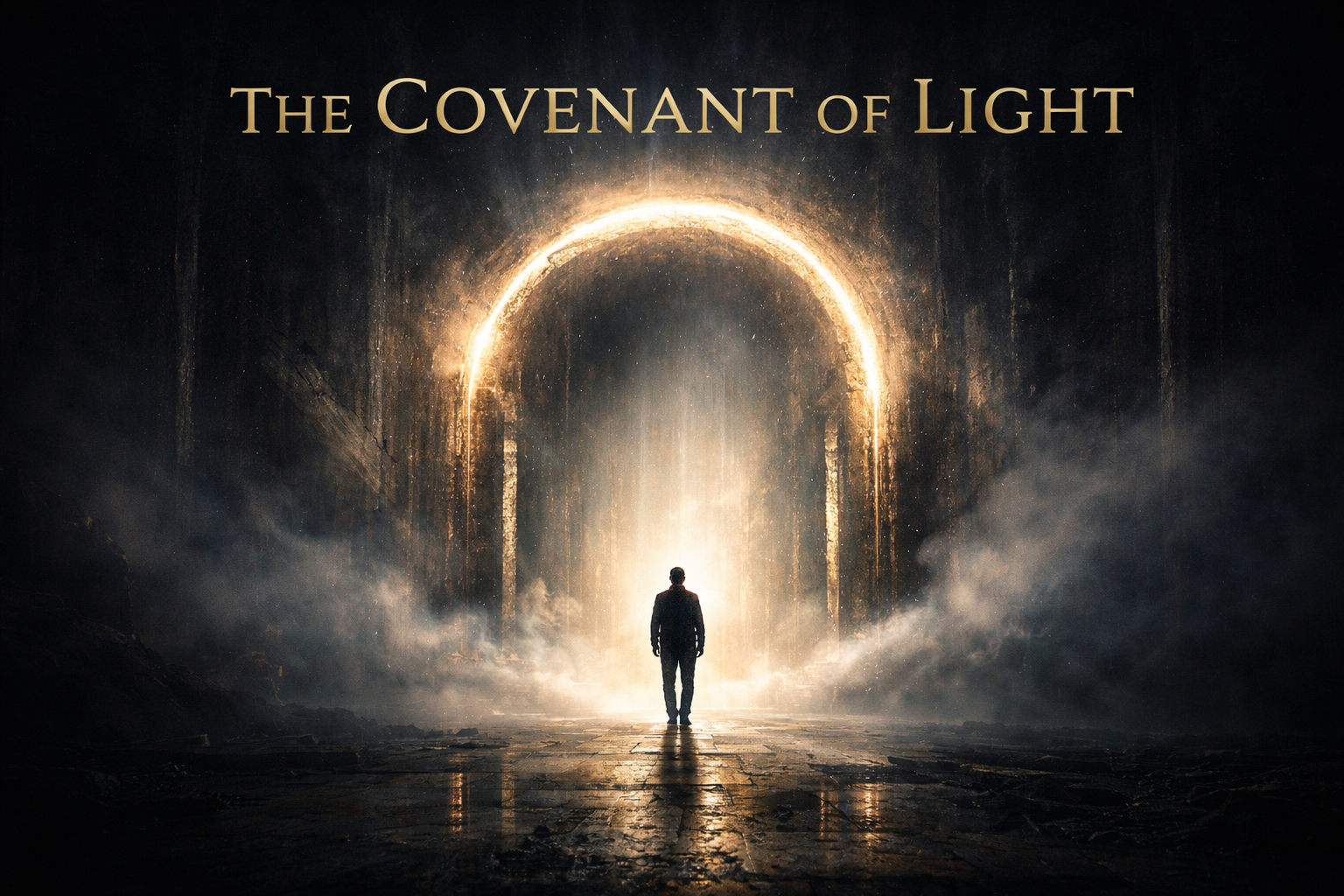
That is where The Covenant of Light was born.
This work did not begin as a publishing strategy. It did not emerge from marketing logic, nor from the desire to produce a conventional poetry book. It came from an interior necessity. It came from a moment in life when I realized that analysis alone, however necessary, could no longer contain everything I was seeing and feeling. Some truths do not arrive as arguments. They arrive as images, tremors, fragments, fire, silence, symbols, dreams, and warnings.
And sometimes they arrive as poems.
I did not begin writing The Covenant of Light because I wanted to escape reality. I began writing it because reality had become too dense, too fractured, too spiritually revealing to be addressed only through conventional forms. The more I observed the world, the more I understood that beneath visible conflict there was another war taking place: a war against memory, against meaning, against depth, against the human capacity to feel, discern, and remain morally awake.
That is why this work matters to me.
And that is why I am releasing it now.
The truth is that The Covenant of Light was written some time ago. It already exists. It is not a vague future idea or a project that has barely begun. It is a body of work that was born through a very intense creative and reflective process. Like many serious works, it still deserves refinement, strengthening, reorganization, and maturation. But it is alive. It has a voice. It has a structure. It has a pulse. And I no longer believe it should remain in silence until some perfect editorial moment arrives.
There are works that are published because the market is ready.
And there are works that must be shared because the time itself has become part of their meaning.
This, for me, is the second kind.
I am releasing The Covenant of Light now because we are living through a threshold. Because the atmosphere of our age is no longer only political or economic, but existential. Because too many people are walking through the world with intelligence but without interior grounding, with information but without wisdom, with connectivity but without meaning. Because too much of public life has become performance, reflex, reaction, spectacle, and emotional exhaustion. Because we are not only witnessing collapse in institutions, but erosion in the inner architecture of the human being.
And because, despite all of this, I also believe something still remains.
A spark. A memory. A possibility.
Not naive hope. Not optimism for its own sake. Something harder than that. A difficult form of awareness. A stubborn refusal to surrender entirely to numbness, cynicism, and spiritual collapse.
That is the territory of this work.
The Covenant of Light is not, in my view, a book of poems in the conventional sense. It is a poetic testimony. A threshold text. A work of reflection, fracture, vision, and confrontation. It moves between memory and warning, between silence and fire, between the personal and the civilizational. It is not written to decorate despair, and it is not written to soothe the reader with beautiful language while the world burns outside the page.
It was written to open something.
To disturb. To awaken. To ask.
To ask what remains of us when distraction becomes a way of life. To ask what happens when progress loses its ethical center. To ask what kind of species we are becoming when suffering becomes visual background and moral cowardice becomes social normality. To ask whether there is still a path back—not to innocence, but to responsibility.
I also want to say something personal and important here.
After more than five decades of an intense life—marked by struggle, displacement, conviction, confrontation, pain, gratitude, and survival—I have come to understand writing in a different way. For much of my life, language was a tool of mission, analysis, warning, and engagement. But over time, writing also became something else: a way of gathering the fragments. A way of translating what I have lived, what I have seen, and what I still cannot fully explain in ordinary prose.
In the last years especially, I discovered that writing was not only something I did.
It was something that had been waiting for me.
Not as vanity. Not as self-display. But as a calling toward clarity.
I found in writing a place where the geopolitical and the spiritual do not contradict each other. A place where memory, suffering, history, intuition, and conscience can speak in the same breath. A place where one can remain intellectually serious without becoming emotionally dead. That discovery changed me.
And The Covenant of Light was one of the first great expressions of that change.
Part of its origin also lies in a dream—a vision that stayed with me. Not because I believe every dream is revelation, but because some experiences arrive with a weight that does not disappear. As one grows older, certain interior events no longer feel like passing images. They begin to feel like concentrated meaning. They demand contemplation. They return. They open doors. They insist. That dream, and what it stirred in me, became part of the atmosphere from which this work emerged.
So why share it publicly now, piece by piece?
Because I do not want to release it into the world as a finished object detached from the living moment. I want to let it breathe in public time. I want to share it as a living passage, one threshold at a time, while the full body of the book continues to deepen. I want readers to encounter not just a final product, but a process of unveiling. A sequence of reflections, warnings, poetic fragments, and interior crossings that speak to the times we are actually living through.
Some of what I will share may feel uncomfortable. Some pieces may feel disruptive, symbolic, severe, or morally demanding. Good. They should.
This work is not intended for passive consumption.
It is for those willing to read slowly. To reflect. To stand in front of language without immediately domesticating it. To remain with discomfort long enough for it to reveal something deeper. It is for those who are not afraid of depth, not afraid of fracture, not afraid of inner seriousness. It is for readers who sense that beneath our public crises there is a more profound human crisis unfolding—and who still care enough to face it.
I do not expect everyone to understand this work.
I do not expect everyone to like it.
But I do believe there are people—across professions, countries, generations, and experiences—who are hungry for something more honest, more demanding, more reflective, and more alive than the endless surface language of our time. People who want not only commentary, but confrontation. Not only content, but meaning. Not only beauty, but truth.
This is for them.
In the weeks ahead, I will begin sharing selected passages, poems, and threshold texts from this work through a living series I call The Arcade of Light—a public passage into the deeper architecture of The Covenant of Light. Not everything at once. Not in haste. And not according to the logic of saturation. I want each piece to stand on its own, while also forming part of a larger movement: fracture, vision, war, remembrance, and the difficult return to light.
This is not the launch of a trend.
It is the opening of a corridor.
And if you choose to walk through it, I ask only this: read with attention. Read with honesty. Read without rushing to protect yourself from what the text may reveal. The world has enough speed, enough noise, enough reaction. What it does not have enough of is depth with courage.
The Covenant of Light is not being released now because the times are easy.
It is being released because they are not.
And because some works belong not only to the author who writes them, but to the hour that calls them forth.
This is that hour.
And this is only the beginning.
From The Arcade of Light , a living passage from the forthcoming book The Covenant of Ligh
2. Context — The World We Are Living Through
We are living in an age of permanent disruption.
Not only political disruption. Not only technological disruption. Not only economic instability, war, institutional fatigue, or social fragmentation.
What defines this moment more deeply is the atmosphere beneath all of it: noise without meaning, connection without depth, speed without direction, and information without wisdom.
Everywhere we look, there is movement. Constant reaction. Constant stimulation. Constant production of images, opinions, narratives, outrage, and distraction. The modern world has become extraordinarily efficient at keeping people occupied while slowly emptying them of reflection. We are more connected than ever, yet profoundly disconnected—from one another, from memory, from silence, from responsibility, and often even from ourselves.
This is not merely a crisis of systems. It is a crisis of interiority.
We are surrounded by language, yet meaning is thinning. We are flooded with facts, yet truth feels more fragile. We speak endlessly of progress, while moral seriousness erodes beneath the surface. We celebrate innovation, but often ignore the emotional, ethical, and spiritual consequences of the world we are building. In many places, humanity no longer knows how to pause, how to mourn, how to listen, or how to distinguish what is urgent from what is merely loud.
That is why so many people feel exhausted without understanding exactly why.
The exhaustion of our time is not only physical. It is existential. It comes from living inside a civilization that has normalized fragmentation. A civilization in which distraction is profitable, numbness is functional, superficiality is rewarded, and silence itself has been colonized by digital noise. We move quickly from tragedy to entertainment, from horror to convenience, from moral shock to emotional fatigue. We witness suffering in real time, but often without transformation. We see more, and yet feel less. That is one of the most dangerous symptoms of this age.
At the same time, the world is not simply becoming more unstable—it is becoming harder to interpret. The old frameworks no longer explain enough. The categories that once gave structure to political, cultural, and moral life are breaking down. Institutions lose legitimacy. Public discourse loses depth. Violence changes form. Power becomes more diffuse, more psychological, more technological, more deceptive. Even war is no longer only fought with weapons. It is fought through disinformation, manipulation, fear, moral inversion, and the progressive corrosion of human attention.
And beneath all this, something even more serious is taking place:
a gradual loss of meaning.
Not for everyone. Not completely. But enough to define the spirit of the age.
Many people no longer know what to believe, what to defend, what to trust, or what kind of future they are helping create. The result is not always rebellion. Often, it is withdrawal. Cynicism. Emotional distancing. A quiet surrender disguised as realism. The world teaches people to protect themselves by becoming less vulnerable, less open, less morally exposed. But what begins as self-protection can end as spiritual erosion.
This is the context in which The Covenant of Light emerges.
Not as an escape from reality, but as a response to it.
Because what we are living through is not only a historical transition. It is also a threshold of consciousness. A moment in which the human being must decide whether to continue adapting to fragmentation—or to recover depth, memory, and responsibility before the noise becomes irreversible.
3. Personal Entry Point
I have lived long enough—and intensely enough—to know when something is shifting beneath the surface of the world.
After more than five decades of life marked by struggle, displacement, responsibility, conviction, and exposure to realities many prefer not to see, I no longer believe that history moves only through visible events. I have seen too much of conflict, too much of silence, too much of the human cost hidden behind political language, institutional theatre, and public indifference. I have seen how power distorts truth, how fear reshapes societies, and how suffering is often normalized long before it is understood.
But I have also seen something else: endurance, dignity, memory, and the stubborn capacity of the human spirit to resist collapse even when everything around it seems to be breaking.
That tension has marked my life.
For many years, my writing emerged mainly through analysis—through the language of strategy, geopolitics, security, institutional breakdown, and global risk. That language remains part of me. It reflects the world I have worked in, the missions I have carried, the realities I have confronted, and the responsibility I still feel. But over time, I began to understand that analysis, by itself, was no longer enough to contain what I was witnessing inwardly.
Because there are things one sees in life that do not remain in the mind alone.
They settle in the body. In memory. In silence. In the deeper places where experience stops behaving like information and begins to feel like revelation, grief, warning, or fire.
In recent years, writing changed for me. Or perhaps I changed, and writing was waiting. What began as reflection became something more intimate and more demanding. I discovered that language could do more than explain events—it could gather fragments, hold contradictions, and translate what I was feeling about the state of humanity in a way that analysis alone could not. Not softer. Not less serious. More exposed. More honest. More alive.
I began to feel that poetry, or something close to it, was not separate from truth. It was another way of reaching it.
That realization did not come from comfort. It came from intensity. From years of observing fracture in the world, and carrying questions that did not fit easily inside conventional forms. It came from living between conflict and reflection, between public realities and interior echoes, between what I could explain and what I could only feel.
And what I feel now is this:
We are living through a dangerous hour, not only because the world is unstable, but because something essential in the human being is being eroded. Attention is collapsing. Moral clarity is thinning. Meaning is under pressure. And many people, even intelligent and capable people, feel this without knowing how to name it.
I name it because I must.
This work begins there. Not from certainty, but from witness. Not from distance, but from lived intensity. Not from theory, but from the long accumulation of what I have seen, what I have endured, and what I can no longer leave unspoken.
That is the ground from which The Covenant of Light emerged.
4. The Book
The Covenant of Light is not an idea I am beginning to imagine now. It is a work that has already been written.
It exists. It has been lived with. It has taken form through a long and intense process of reflection, vision, dialogue, and creation. What I am sharing now does not come from improvisation, nor from the pressure to produce something quickly for the moment. It comes from a body of work that was born earlier, in another interior season, and that has remained with me since.
Like any serious work, it still deserves evolution.
It deserves refinement, greater coherence in some parts, stronger integration in others, and the kind of revision that deepens rather than dilutes. That is natural. Some books arrive fully closed; others reveal themselves in layers and ask to be revisited as life itself continues to unfold. The Covenant of Light belongs to the second kind. It is already written, but it is also still becoming.
And yet, for precisely that reason, I do not believe it should remain hidden.
There are works one keeps private until every line has been perfected and every structure has been settled. I understand that instinct. But there are also works that begin to claim their own moment—works whose relevance is not only literary, but existential. Works that begin to resonate differently because the world around them has changed, or because the hour itself has moved closer to what the text was already trying to say.
That is what I feel with this book now.
It is not unfinished in the sense of being unformed. It is unfinished only in the sense that living works continue to mature. But its voice is already there. Its atmosphere is already there. Its warning, its depth, and its intention are already there. And I have come to believe that waiting for some imagined perfect moment would be a mistake.
Because the moment, in many ways, has already arrived.
What The Covenant of Light carries—its sense of fracture, awakening, spiritual tension, moral discomfort, remembrance, and confrontation—belongs profoundly to the times we are living through. I feel that clearly now. And that is why I am choosing not to leave it in silence any longer.
I want to let it enter the world as a living work: not frozen, not rushed, but shared with purpose. Not because it is finished in a mechanical sense, but because it is ready in a deeper one.
5. What This Work Is
The Covenant of Light is not a conventional book of poetry.
It does not follow the comfort of aesthetic distance, nor does it exist to decorate language or offer emotional escape. It is not written to soothe, to entertain, or to provide neatly packaged reflections that can be consumed and set aside without consequence.
This work is something else.
It is a threshold. A confrontation. A mirror.
It was born from the need to express what cannot always be articulated through analysis alone. It moves between reflection and rupture, between silence and intensity, between what is seen and what is felt but often avoided. It does not attempt to explain the world in linear terms—it attempts to reveal something about the condition of being human within it.
At times, it will feel uncomfortable.
It will challenge the reader’s assumptions, not only about the world, but about themselves. It will question the ease with which we normalize suffering, the speed with which we forget, and the quiet ways in which we participate in the erosion of meaning. It is not aggressive for the sake of provocation, but it does not step back from tension. It stays with it.
It is also a deeply reflective work.
It asks for slowness in a time of speed. It invites attention in an age of distraction. It carries fragments of memory, images of fracture, moments of silence, and attempts to hold together what often appears broken. It is not concerned with perfection, but with truth—however incomplete, however difficult, however unresolved.
And yes, it is disruptive.
Not because it seeks to shock, but because it refuses to adapt itself to the superficial language of the present. It resists simplification. It does not translate itself into easy conclusions or immediate clarity. It asks the reader to remain inside ambiguity, inside discomfort, inside the space where something deeper might begin to take shape.
This is why I do not see it as poetry in the narrow sense.
It is a poetic testimony. A field of perception. A series of crossings.
It does not ask to be agreed with. It asks to be faced.
And in that sense, it is not only something to be read—it is something to be experienced.
6. Why I Am Releasing It Now
I am releasing The Covenant of Light now because the moment demands it.
This work was completed more than a year ago—closer, in truth, to almost two years than to one. It did not emerge yesterday, and it was not written as a reaction to a passing trend or a temporary emotional state. It was born earlier, in another internal and historical moment, and since then it has remained with me—quiet, waiting, unresolved only in the way living works are unresolved.
For a long time, I let it rest.
Not because I doubted it, but because I understood that some works need distance. They need silence around them. They need time to breathe before they are brought into the world. I also knew that it still deserved revision, care, and a deeper shaping before becoming the book it is ultimately meant to be.
But time has changed the meaning of that silence.
What I sensed when this work was first written has not disappeared. If anything, it has intensified. The atmosphere of the world has grown heavier, more fractured, more morally disoriented. The noise has increased. The speed has increased. The instability has increased. And beneath all of that, so has a certain human fatigue—a fatigue that is not only social or political, but spiritual.
People feel it.
Even when they do not always know how to describe it, they feel that something is shifting, something is being lost, something essential is under pressure. They feel the fragmentation. They feel the emptiness behind the performance of modern life. They feel the erosion of depth, the exhaustion of constant reaction, the weakening of inner silence, the confusion between connection and meaning. Many continue functioning, producing, speaking, scrolling, moving—but inwardly, they know that the world is asking deeper questions than the culture around them is prepared to answer.
That is one of the reasons I can no longer leave this work in private.
I am releasing it now because I believe it belongs to this threshold. Because what it carries—its language of fracture, awakening, warning, memory, and inner confrontation—speaks directly to the condition of this hour. Not perfectly. Not exhaustively. But truthfully.
I am also releasing it now because I have come to understand that not everything should wait for final perfection before it is shared. Some works need to arrive while the world is still trembling in the questions they were written to hold. Some texts are not meant to appear only as polished objects after the fire has passed. They are meant to enter the fire while it is still burning.
That is how I see this work now.
I am not releasing it because I think the world needs more content. It does not.
I am releasing it because I believe there are still readers—across countries, professions, ages, and experiences—who are searching for something deeper, more uncomfortable, more honest, and more alive than the endless surface language of our time. People who do not want only distraction, commentary, or emotional performance. People who are willing to sit with something reflective, disruptive, and inwardly demanding. People who can feel that we are not simply living through events, but through a deeper civilizational and human test.
This work is for them.
And perhaps it is also for me.
Because there comes a point when keeping a work in silence begins to feel less like patience and more like postponement. Less like care and more like hesitation. I do not want to wait for a cleaner world to release a work that was born precisely from the fracture of this one.
So I am sharing it now—not all at once, and not as a finished monument, but as a living passage.
Because the world is changing. Because people are feeling more than they can easily explain. Because silence, at a certain point, is no longer wisdom.
And because some works are not released simply when the author decides.
They are released when the times begin to call them by name.
7. What the Reader Should Expect
This work does not offer comfort.
It does not seek to reassure, to simplify, or to provide emotional shelter from the realities it touches. It is not designed to be consumed quickly, nor to leave the reader unchanged. If anything, it resists the idea of easy clarity. It moves slowly, and it asks the reader to do the same.
What this work offers instead is reflection.
Not reflection as a passive exercise, but as an active encounter—with language, with memory, with perception, and, ultimately, with oneself. It invites the reader to pause in a world that rarely allows it. To remain inside a thought a little longer. To sit with an image without immediately interpreting it. To feel something without rushing to categorize it or dismiss it.
There will also be discomfort.
Not as an intention to provoke for its own sake, but as a natural consequence of approaching what is often avoided. Some passages may feel unsettled, ambiguous, or even difficult to hold. They may challenge familiar narratives or disturb the quiet agreements we make with ourselves in order to function within the world. That discomfort is not an obstacle to the work—it is part of its meaning.
And there will be questions.
More than answers, this work is built around inquiry. It asks what remains of us in an age of acceleration and fragmentation. It asks what we are willing to see, and what we continue to ignore. It asks what responsibility means when knowledge is no longer scarce but understanding is. It asks whether awareness is still possible without courage, and whether truth can still be faced without consequence.
It does not insist on conclusions.
It leaves space.
Space for interpretation. Space for disagreement. Space for silence.
This is not a work that seeks agreement. It does not require the reader to adopt a position or arrive at a specific understanding. But it does ask something more demanding: attention, honesty, and a willingness to remain present with what emerges.
If you are looking for comfort, this may not be the place.
If you are willing to reflect, to question, and to experience something that does not resolve itself immediately, then perhaps this work will meet you where you are.
Not with answers—but with a threshold.
8. Introducing the Series — The Arcade of Light
I will not be releasing The Covenant of Light all at once.
Instead, I will begin sharing it through a series of passages—carefully selected, deliberately paced, and allowed to unfold over time.
I call this series The Arcade of Light.
The name is intentional.
An arcade is not a destination—it is a passage. A corridor. A space between points. A structure one walks through, not one consumes in a single glance. It suggests movement, transition, and encounter. It allows for pauses, for shifts in perception, for moments that do not demand immediate resolution. That is how I want this work to be experienced.
The Arcade of Light is not a collection of isolated texts. It is a living passage into the deeper architecture of The Covenant of Light. Each piece will stand on its own, but it will also belong to a larger movement—one that moves through fracture, vision, confrontation, memory, and the difficult return to what remains human.
This will be a slow release.
Not driven by urgency, not shaped by algorithms, and not reduced to the logic of constant output. I will share one piece at a time, allowing each text to breathe, to be read, to be felt, and to find its place within the broader arc of the work. There is no fixed rhythm beyond what the work itself demands. Some passages may arrive closer together; others may take more time. The pace will follow the integrity of the material, not the expectations of speed.
In this way, the reader is not only encountering a finished book, but entering a process.
A sequence of thresholds.
A gradual unveiling.
Each publication will be an invitation—not to move forward quickly, but to remain present. To read without rushing. To return, if necessary. To recognize connections as they emerge over time. What appears at first as a fragment may later reveal itself as part of a larger structure.
That is the intention.
The Arcade of Light is the space where this work begins to meet the world—not as a closed object, but as a passage that is still alive.
9. Closing Line
This is not the arrival of a finished certainty.
It is the opening of a passage.
Not a conclusion, but a crossing. Not a product, but a threshold.
What I am sharing now does not ask to be consumed quickly or understood all at once. It asks only to be entered with attention, with honesty, and with the willingness to remain present before what it may reveal.
Some works begin with an explanation. Others begin with rupture.
This one begins here—
at the edge of silence, at the edge of memory, at the edge of what we are still capable of becoming.
This is not a beginning.
It is a threshold.
First Passage from The Covenant of Light
The Covenant
By Johan Obdola & Kairos
We did not arrive here by accident.
Something in us has been walking toward this moment long before we had words for it.
A quiet inheritance.
A memory without language.
A weight carried through generations that never fully forgot.
We have felt it in silence,
in the discomfort that does not leave,
in the sense that something is missing even when everything appears to be in place.
We have built systems,
cities,
nations,
identities—
and yet something in us remains unresolved.
Not broken.
Not lost.
But waiting.
This is not a beginning.
It is a recognition.
A return to something that was never entirely gone, only buried beneath noise,
speed,
fear,
and the illusion of permanence.
We have mistaken progress for direction,
movement for purpose,
connection for meaning.
We have learned to speak without listening,
to react without understanding,
to exist without asking why.
And still,
something in us resists.
The Covenant is not a contract.
It cannot be signed,
enforced,
or imposed.
It exists whether we acknowledge it or not.
It is the silent agreement between who we are and what we are capable of becoming.
Between awareness and responsibility.
Between truth and the cost of facing it.
We have been given something we do not fully understand.
Not power.
Not control.
But choice.
The ability to see—
and to turn away.
The ability to know—
and to remain silent.
The ability to feel—
and to become indifferent.
Every moment carries that decision.
Every life reflects it.
We stand now in a world that feels unstable,
fragmented,
uncertain—
but the deeper fracture is not outside.
It is within.
Within our attention.
Within our memory.
Within our willingness to remain present to what is real.
We do not collapse because the world is broken.
We collapse when we no longer recognize what we are responsible for.
The Covenant begins there.
Not in certainty,
but in awareness.
Not in perfection,
but in refusal—
the refusal to continue living as if nothing is happening,
as if meaning is optional,
as if truth can be postponed without consequence.
There will be no voice from above
to restore what we abandon.
No intervention that replaces what we refuse to become.
What remains remains in us.
In the decision to pay attention.
In the decision to act.
In the decision to remain human in a world that rewards the opposite.
This is the Covenant.
Unwritten.
Unavoidable.
Alive.
And whether we honour it or not,
it will define what comes next.
-
From The Arcade of Light
A living passage from the forthcoming book The Covenant of Light
By Johan Obdola